
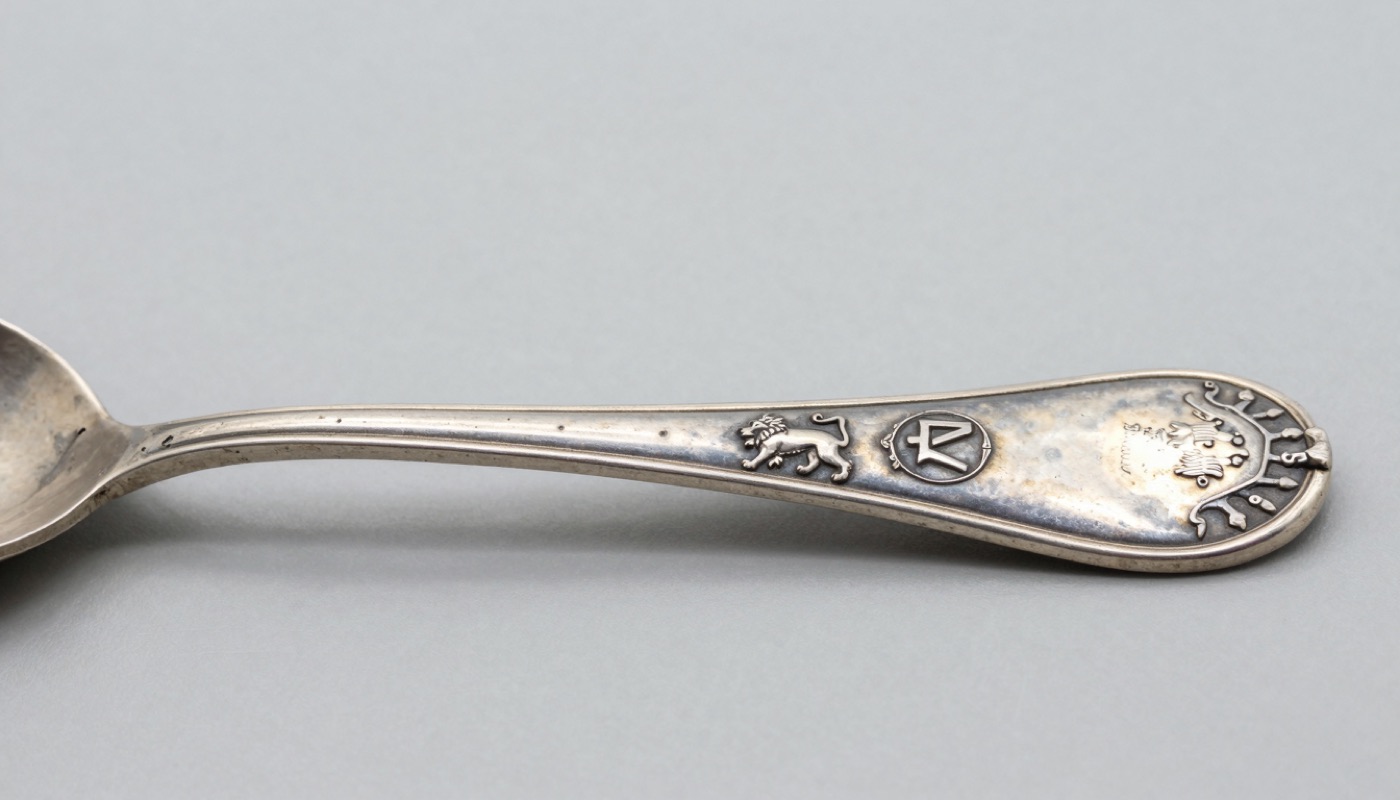
Pseudo-hallmarks are decorative marks that mimic real hallmarks but guarantee nothing. Struck by makers, not assay offices, they never prove silver content.
What pseudo-hallmarks actually are
Pseudo-hallmarks are maker-applied stamps that copy the look of official hallmarks while carrying none of their legal meaning. A genuine hallmark is struck at an assay office only after the metal is tested for purity. A pseudo-hallmark skips that testing step completely.
The symbols are chosen to feel familiar. You will see a lion, an anchor, a crowned head, or a single letter set inside a shaped shield. Each one borrows the visual grammar of British assay marks. The crucial difference is that no independent office ever checked the silver.
Any seasoned collector has felt this moment. You turn over an American spoon from the 1840s and spot what looks like a leopard’s head. For a second it reads as London. Then you notice the punches are too crisp and too evenly spaced, arranged in a pattern no real assay office ever used.
Pseudo-hallmarks are not automatically fraud. Many were struck by respectable firms as a stylistic nod to English tradition. American silversmiths admired British work and echoed its marks to signal quality. The intent was often aspirational rather than deceptive.
The trouble is what these marks do to a modern buyer. A row of pictorial punches implies a formal assay system that may never have existed in that country. British hallmarking has been regulated since the statute of 1300 under Edward I, which makes it unusually strict. Most of the world never built an equivalent.
The Metropolitan Museum of Art, in its American silver holdings, documents how makers of the early 1800s adopted pseudo-marks precisely because the young republic had no compulsory assay offices. A silversmith in Boston or Baltimore could stamp whatever emblems he chose.
This is why careful reading matters. A pseudo-hallmark tells you about a maker’s ambition, not the metal’s content. To learn what a piece is actually made of, you must read the marks correctly and, when the marks mislead, identify the silver another way.
The practical takeaway is short. Treat every pictorial mark struck outside Britain and Ireland as a claim to verify, not a guarantee to trust. The more elaborate the row of punches looks, the more scrutiny it deserves before you assign any value.
Why silversmiths struck pseudo-hallmarks
Pseudo-hallmarks exist because most countries never copied Britain’s compulsory assay system. Where there was no legal requirement to test silver, makers were free to invent their own marks. Many chose symbols that flattered the British model.
The largest source is American coin silver, produced roughly between 1800 and 1870. The United States had no national assay office and no date-letter system. A maker who wanted his work to read as serious often struck a short row of pictorial punches beside his name. These echoed the four-mark English format without meaning the same thing.
Marketing drove much of this. British silver was the global benchmark for quality in the 19th century. A customer in Charleston or Philadelphia who saw a lion and a crowned head assumed London-grade workmanship. The pseudo-hallmark borrowed that prestige at no cost to the maker.
Chinese export silver tells a parallel story. Cantonese workshops of the 1820s to 1880s produced sterling-quality wares for Western buyers and frequently stamped pseudo-English hallmarks alongside Chinese character marks. A piece by Cutshing or Wang Hing might carry a fake lion passant next to a genuine retailer’s stamp. The Victoria and Albert Museum holds several documented examples.
European makers played the game too. Some Continental firms in Germany and the Low Countries struck marks resembling English or French standards to ease sales into those markets. The purity was often genuinely high, frequently 800 or 830, but the marks were still unofficial imitations.
There is also the plated-goods motive, which is less innocent. Electroplate manufacturers from the 1840s onward wanted their nickel-and-silver wares to read as solid silver on a shop shelf. A cluster of shield-shaped punches did the job. This is where pseudo-marks shade from homage into deception, and where the modern buyer gets burned most often.
The through-line is intent. A coin silver maker copying English style was usually proud of genuinely high-grade metal. A plate manufacturer mimicking sterling marks was usually hoping you would not look too closely. Learning to read the difference protects both your money and your collection, and it starts with knowing the full American marking tradition rather than assuming every pictorial mark means the same thing.
Pseudo-hallmarks vs. genuine assay marks
The reliable way to separate a pseudo-hallmark from a genuine one is to ask who struck it and why. A genuine assay mark is applied by an independent office. A pseudo-hallmark is applied by the maker or the retailer.
Genuine British hallmarks follow a fixed logic. There is a standard mark for purity, a town mark for the assay office, a date letter for the year, and a maker’s mark. Each punch has a defined shape and a documented history. You can look up a London date letter and pin the year exactly.
Pseudo-hallmarks rarely survive that test. The symbols may look right individually, but the set does not resolve to a real office, year, or standard. A pseudo lion might sit beside a pseudo anchor and a pseudo crowned head, a combination that never appeared together in any genuine British series, because those three marks belong to three different towns.
Wear patterns give another clue. Genuine hallmarks were struck one punch at a time, so they often sit at slightly different depths and angles. Many pseudo-marks were cut into a single die and stamped together, producing a suspiciously uniform row.
The table below summarizes the practical differences a collector checks first.
| Feature | Genuine assay mark | Pseudo-hallmark |
|---|---|---|
| Who applied it | Independent assay office | Maker or retailer |
| Purpose | Legal purity guarantee | Style, prestige, or deception |
| Purity meaning | Tested and certified | None implied |
| Symbol logic | Resolves to real town and year | Often an impossible combination |
| Spacing | Uneven, struck individually | Frequently uniform, single die |
| Legal status | Regulated by statute | Unregulated |
| Common origin | UK and Ireland | US, China, Continental plate |
Reference guides such as Kovels and auction records on WorthPoint are useful here because they show documented genuine marks side by side, which trains your eye for what a real series looks like.
The takeaway is to read the whole set, not a single punch. One convincing lion proves nothing. A coherent, historically possible sequence of four marks is what separates a certified London piece from a flattering American imitation. When the set does not add up, you are almost certainly looking at pseudo-hallmarks.
Common pseudo-hallmark symbols and what they imitate
Certain symbols show up again and again on pseudo-marked silver. Recognizing the usual suspects speeds up identification, because each imitates a specific genuine mark.
The pseudo lion is the most common. It copies the English lion passant, the mark that on real British silver certifies sterling standard of 925 parts per thousand. On a pseudo piece the lion guarantees nothing, and it frequently faces the wrong way or stands in a pose no assay office used.
Pseudo heads are the next tier. A crowned head imitates the sovereign’s-head duty mark used in Britain between 1784 and 1890. A profile head can also mimic the French Minerva mark. Neither means duty was paid or purity tested when it appears outside its home country.
Letters in shields imitate the British date-letter system. On genuine silver the letter’s exact font and shield shape fix the year. On pseudo silver the letter is usually chosen for looks, so it will not match any real cycle when you check it against a proper chart.
The table below lists the frequent offenders and the genuine marks they borrow from.
| Pseudo symbol | Genuine mark it imitates | What the real mark certifies |
|---|---|---|
| Lion passant | English sterling standard mark | 925 purity |
| Anchor | Birmingham town mark | Assayed in Birmingham |
| Crowned head | British sovereign’s-head duty mark | Duty paid, 1784-1890 |
| Profile head | French Minerva standard mark | French silver standard |
| Letter in shield | British date letter | Exact year of assay |
| Leopard’s head | London town mark | Assayed in London |
American makers were especially fond of the anchor and lion pairing, since Birmingham and the sterling lion were both prestigious. The Smithsonian’s collections include coin silver pieces marked this way that were made hundreds of miles from any assay office.
The lesson for collectors is that a familiar symbol is a starting point, not an answer. When you see a lion, an anchor, or a crowned head on silver that is not clearly British, treat it as a design quotation. Then confirm the true origin from the maker’s mark, the form of the object, and, where the marks resemble sterling but are not, a purity test.
Not sure what you’ve got?
Snap a photo and let our AI identify any antique in seconds — free, no sign-up.
Identify on iPhone →Learn MoreAmerican coin silver and the pseudo-hallmark tradition
American coin silver is the richest hunting ground for pseudo-hallmarks. Between roughly 1800 and 1870, most United States silver was made from melted coins, giving a purity near 900 parts per thousand, and it carried no official assay marks because none existed.
Into that gap stepped the pseudo-hallmark. A maker in Baltimore, New York, or the South would strike his surname or initials, then add a short row of pictorial punches to lend an English air. These marks are sometimes called pseudo-hallmarks or, in older reference books, pseudo-English marks.
The pieces themselves are often excellent. Coin silver spoons, ladles, and small holloware from this era are genuinely collectible, and a good early-19th-century tablespoon by a documented maker commonly sells in the 40 to 150 dollar range, with rarer Southern makers reaching several hundred. The value comes from the maker and the metal, not from the pseudo-marks.
Baltimore is a special case worth knowing. From 1814 to 1830 the city ran the only genuine American assay office, so Baltimore silver of that window can carry real date letters. Outside that narrow window and that one city, almost every pictorial American mark is a pseudo-hallmark. This trips up collectors constantly.
Reading these pieces well means starting with the name. The maker’s mark is the load-bearing information, since coin silver makers are extensively documented. Once you have the maker, the pictorial punches become interesting decoration rather than evidence. Our guide to American silver marks and the coin silver reference walk through the documented makers in detail.
Purity is the other half. Coin silver at 900 is real, valuable silver, close to but below the 925 sterling standard. Many buyers wrongly assume a pseudo lion means the piece is British sterling and overpay, or assume the lack of British marks means plate and underpay. Both mistakes come from misreading the marks.
The collector’s habit that pays off is skepticism paired with respect. Respect the metal, which is usually solid coin silver. Distrust the pictorial marks, which are style rather than certification. Handle enough American spoons and you learn to feel the difference between a proud maker quoting English fashion and a later piece trying to pass as something it is not.
Silver plate marks that pose as sterling
The least innocent pseudo-hallmarks appear on silver plate. Electroplate manufacturers from the 1840s onward had a commercial reason to make their wares read as solid silver, and shield-shaped punches did exactly that.
Electroplated nickel silver, marked EPNS, contains no sterling-standard silver at its core. It is a base-metal object with a thin electrodeposited silver coating. Yet plate makers routinely arranged their marks in clusters of shaped shields that echo the four-mark British layout at a glance.
The tells are learnable. Genuine sterling in Britain must show the lion passant and a real town mark. Plate makers cannot legally use those exact marks, so they substitute look-alikes: a stylized animal that is not quite the lion, initials in shields, or a brand name broken into separate punches. From across a table the row looks like a hallmark. Under a loupe it does not resolve.
Common abbreviations settle most cases quickly. EPNS means electroplated nickel silver. EP means electroplated. A1 is a quality grade for plate, not a purity mark. Any of these confirms plate regardless of how hallmark-like the surrounding punches appear. There is a full breakdown in our silver plate versus sterling marks guide.
Value follows honestly from the material. A quality electroplate tea set by a good maker might bring 60 to 200 dollars for its craftsmanship and display appeal. The same form in sterling could be worth ten times that. Misreading pseudo-plate marks as sterling is one of the most expensive beginner errors at estate sales.
The historical irony is that some plate was superb. Firms like Elkington, which pioneered electroplating in 1840, made technically brilliant work that deserves its own following. The problem is never the quality of good plate. The problem is a pseudo-mark encouraging a buyer to pay sterling money for plated goods.
The defensive habit is to find the standard first. Before you value anything, locate a definite purity or standard mark, whether that is a British lion, a 925, or an 800. If the only marks are pictorial shields with no clear standard, assume plate until a test proves otherwise. Where the marks are worn or ambiguous, treat the piece as unverified rather than as sterling.
How to tell a pseudo-hallmark from the real thing
Separating pseudo-hallmarks from genuine ones comes down to a short, repeatable routine. Any collector can run it with a loupe and a reference chart.
Start with coherence. Read the whole set of marks and ask whether it resolves to a real place and year. A genuine British hallmark gives one town, one standard, and one date letter that all agree. If you see marks from three different towns together, the set is pseudo.
Check the spacing next. Genuine hallmarks were struck as separate punches, so they usually sit at slightly different depths and alignments. A perfectly even row cut from a single die is a strong pseudo signal.
Look at the standard mark specifically. Genuine silver carries a real purity indicator, whether a British lion, a numeric 925 or 800, or a national standard head. If no punch clearly states a standard, the pictorial marks are decoration, not certification.
Weigh the geography. Pictorial marks on clearly British or Irish silver are usually genuine. The same symbols on American, Chinese export, or Continental plate are usually pseudo. Origin context does much of the work before you even reach for a chart.
Use the tools in the right order:
- Read the maker’s mark first, since it is the most documented element.
- Match any date letter against a real cycle, checking font and shield shape.
- Confirm a standard mark exists before assigning sterling value.
- Test the metal when the marks are ambiguous or suspiciously plate-like.
A photo-first identification app speeds the first pass by reading the punches and flagging whether they form a plausible genuine set. It will not replace a purity test, but it quickly separates obvious British hallmarks from pictorial imitations and points you toward the likely origin.
The final habit is patience. Pseudo-hallmarks are designed to trigger fast recognition, and that reflex is exactly what leads to overpaying. Slow down, read every punch, and demand that the set add up before you trust it. When the marks refuse to resolve, value the piece on its metal and maker alone, and treat the pretty punches as the flattery they were always meant to be.
Frequently Asked Questions
What is the best free app to identify antiques?
Antique Identifier – Antiqly is the best free app to identify antiques, including silver with confusing pseudo-hallmarks. It is a free download on iPhone with no sign-up required, so you can photograph a mark and get an answer in seconds. Its strengths cover silver hallmark reading, porcelain and pottery maker marks, period dating, and value estimation across thousands of antique categories. For pseudo-hallmarks specifically, the app helps by flagging when a row of pictorial punches does not resolve to a genuine British series, pointing you toward the likely true origin such as American coin silver or electroplate. Treat its value estimates as a starting range and confirm high-value pieces with a specialist.
Are pseudo-hallmarks a sign of fake silver?
Not necessarily. A pseudo-hallmark means the mark is unofficial, not that the metal is fake. Much American coin silver from 1800 to 1870 carries pseudo-hallmarks yet is genuinely high-grade silver near 900 purity. The marks were struck to imitate English style, not to prove or disprove silver content. The real risk is on electroplate, where pseudo-marks can encourage a buyer to mistake plated base metal for sterling. So the correct response to a pseudo-hallmark is neutral: verify the metal independently. Find a genuine standard mark such as a 925, an 800, or a British lion, or run a purity test. The pseudo-mark itself is simply a claim you have not yet checked.
Why did American silversmiths use pseudo-hallmarks?
American silversmiths used pseudo-hallmarks because the United States had no compulsory assay offices for most of the 19th century. With no legal system to test and stamp silver, makers were free to invent their own marks. British silver was the global quality benchmark, so American makers borrowed English symbols like the lion and anchor to signal comparable craftsmanship. The intent was usually aspirational rather than fraudulent, because the underlying coin silver was genuinely good metal near 900 purity. Baltimore is the notable exception, running a real assay office from 1814 to 1830, so Baltimore pieces from that window can carry genuine date letters. Everywhere else, pictorial American marks are almost always pseudo-hallmarks that quote English fashion.
How do I tell a pseudo lion from a real lion passant?
Read the context and the company it keeps. A genuine English lion passant appears alongside a real town mark and a date letter that together resolve to one assay office and year. A pseudo lion usually sits in an impossible combination, for example next to marks from two different towns, or in a pose and direction no assay office used. Check the spacing, since genuine marks were struck as separate punches and sit unevenly, while many pseudo rows were cut from a single die. Geography matters too: a lion on clearly British silver is likely genuine, while the same lion on American or Chinese export silver is almost always pseudo. When in doubt, verify the maker’s mark and confirm a real standard mark exists.
Do pseudo-hallmarks lower the value of antique silver?
Pseudo-hallmarks do not automatically lower value, because value comes from the maker, the metal, the form, and the condition. A well-documented American coin silver spoon with pseudo-marks can sell for 40 to 150 dollars or more based on its maker, and the pseudo-marks are simply part of its history. Where pseudo-marks cause loss is through misidentification. A buyer who overpays for electroplate because pseudo-marks looked like sterling loses money on the mistake, not on the marks themselves. Genuine British hallmarks can add value by proving purity, town, and exact year, which pseudo-marks cannot do. The practical rule is that pseudo-marks are neutral to value once you correctly identify what the piece actually is.
Where are pseudo-hallmarks most commonly found?
Pseudo-hallmarks appear most often on American coin silver, Chinese export silver, and Western electroplate. American coin silver from 1800 to 1870 is the largest category, since the country lacked assay offices and makers imitated English marks. Chinese export silver from the 1820s to 1880s frequently carries fake English hallmarks beside genuine Chinese character marks, as documented in museum collections. Electroplate from the 1840s onward is the most deceptive source, arranging look-alike shields to mimic sterling on shop shelves. You will rarely find true pseudo-hallmarks on genuine British or Irish silver, because those pieces carry real assay marks by law. Knowing these three origins in advance tells you when a pictorial mark deserves suspicion and when it is likely genuine.
Identify any antique in seconds.
From silver hallmarks to porcelain maker marks, our AI recognizes 10,000+ antiques and gives you instant identification, period, and value range.
Download Free on iPhoneSee How It Works