
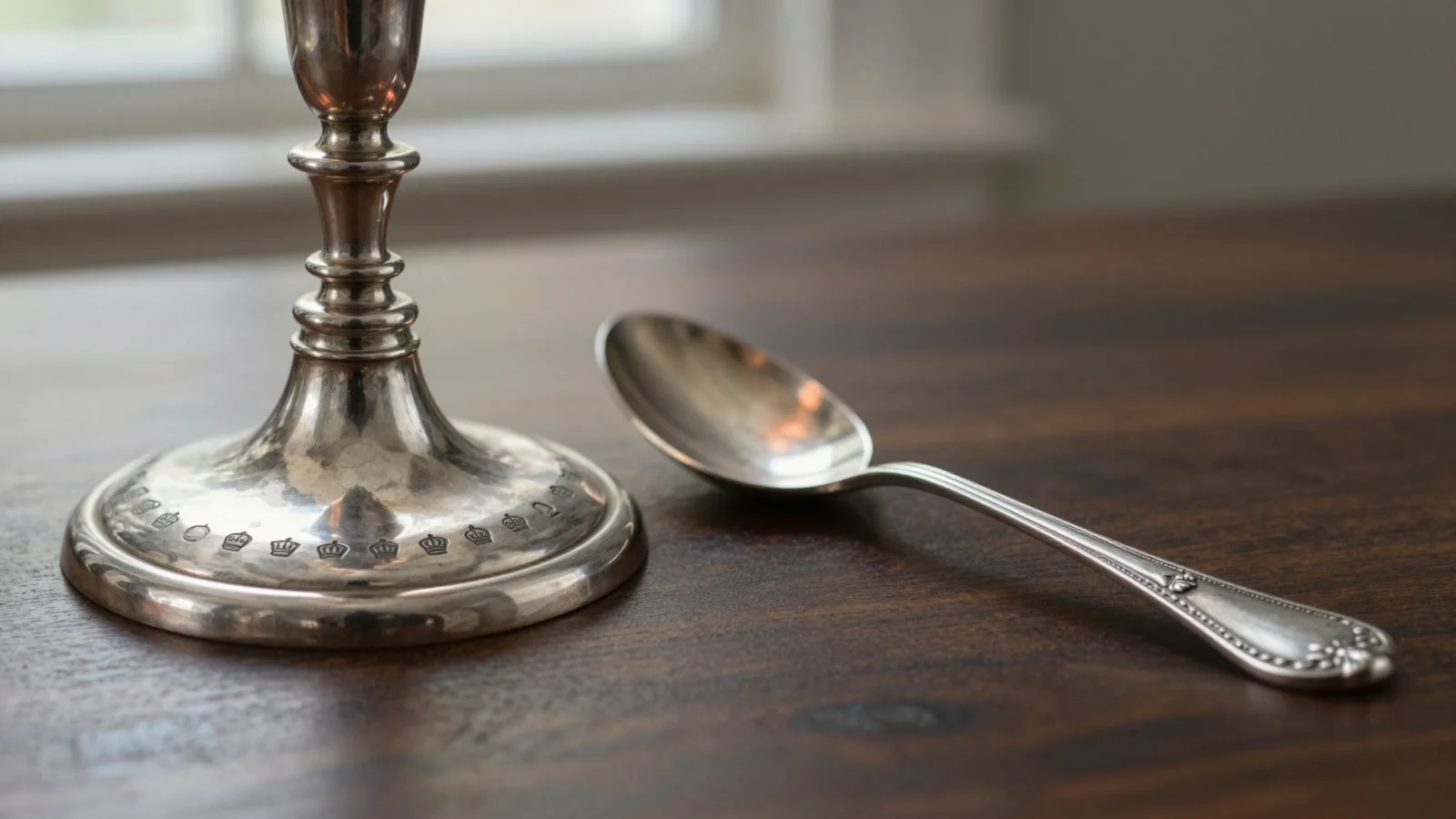
Silver plate marks are stamps such as EPNS, EP, A1, or a maker’s name that identify silver-plated wares rather than solid silver. They are trade marks, not legal hallmarks. This guide decodes plate marks by maker and country, shows how they imitate hallmarks, and explains which plated pieces hold real value.
What do silver plate marks mean?
Silver plate marks are manufacturer stamps that identify a base-metal object coated with a thin layer of pure silver. They carry no legal guarantee of silver content. A British hallmark is struck by an independent assay office after the metal has been tested. A plate mark is struck by the factory itself, and it describes a manufacturing process, not a purity.
The most common British plate mark is EPNS, short for electroplated nickel silver. The body of an EPNS piece is nickel silver, an alloy of roughly 60 percent copper, 20 percent nickel, and 20 percent zinc. It contains no silver at all. A layer of pure silver, usually between 2 and 10 microns thick, is deposited over that body by electroplating. Elkington and Co of Birmingham patented the commercial process in 1840. Within a decade, electroplate had replaced solid silver on most middle-class tables.
Related marks follow the same logic. EP alone means electroplate. EPBM means electroplated Britannia metal, a soft tin alloy used for teapot bodies. Silver on Copper means electroplate over a copper base. A1 is a plating quality claim, not a silver standard. Our EPNS marks reference covers each of these in maker-by-maker detail.
One rule saves beginners hours of confusion. Plated wares never carry a lion passant, an anchor, or an official date letter. Those symbols belong to the UK hallmarking system and are reserved for solid silver. If a piece shows EPNS anywhere, stop searching for a date letter. No assay office ever tested it.
The reverse also holds. A full hallmark row with a lion passant means sterling, even when the piece sits in a box of plated flatware. Check every item individually. Any seasoned collector has pulled a sterling ladle out of a job lot priced as plate, and that habit pays for itself quickly. See our sterling identification guide for the full hallmark sequence.
How do plate marks imitate real hallmarks?
Plate makers arranged their stamps in rows of four or five small punches so that, at arm’s length, they resemble the hallmarks struck on sterling silver. Collectors call these pseudo-hallmarks. They were legal for most of the nineteenth century, and they still trip up buyers at every antiques fair.
The imitation worked through three tricks. First, the word EPNS was split into four separate shields, one letter per punch, echoing the four-mark sterling row. Second, makers registered trademark animals and crowns that suggest official symbols without copying them exactly. Third, single letters in shaped shields imitate date letters while actually recording a pattern or size code.
| Stamp you see | What it imitates | What it actually means | Where it appears |
|---|---|---|---|
| Crown | Sheffield assay town mark | Maker trademark; outlawed on British plate in 1896 | British electroplate made before 1897 |
| Walking lion lookalike | Lion passant sterling mark | Decorative trademark beast, often front-facing or holding a banner | British and American plate |
| E, P, N, S in separate shields | A four-mark hallmark row | The word EPNS split into single-letter punches | British plate from about 1860 |
| Single letter in a shield | Assay date letter | Pattern, size, or workshop batch code | All countries |
| Pennant flag | Nothing official | Walker and Hall trademark | Sheffield electroplate |
| Trumpet with banner | Nothing official | James Dixon and Sons trademark | Sheffield flatware and hollowware |
| Crossed keys or arrows | Continental hallmarks | Registered maker trademark | Export electroplate |
The crown row carries a genuine dating clue. Because the crown was the official mark of the Sheffield Assay Office, its use on plated goods was banned in 1896. A British plated piece with a crown in the mark row was therefore made before 1897.
Read the letters, not the layout. A hallmark row spells nothing; a plate row usually spells EPNS, EP, or a firm’s initials. Our comparison of silver plate marks vs sterling hallmarks walks through photographed examples side by side.
Sheffield Plate vs electroplate: telling them apart
Old Sheffield Plate is silver fused onto copper by heat and rolling, while electroplate is silver deposited by electric current onto an already-shaped base-metal object. The two are different technologies from different eras, and the market treats them very differently.
Thomas Boulsover of Sheffield discovered the fusion process around 1743. Makers rolled ingots of copper faced with sterling sheet, then worked the laminated metal like solid silver. The trade thrived until Elkington’s 1840 electroplating patent undercut it; by the mid-1850s fused plate was effectively dead. The Victoria and Albert Museum holds documented examples of both processes, and comparing them in person is the fastest education available.
| Feature | Old Sheffield Plate | Electroplate |
|---|---|---|
| Working period | About 1745 to the 1850s | 1840 to the present |
| Base metal | Copper | Nickel silver or Britannia metal |
| Silver layer | Sterling sheet fused before shaping | Pure silver deposited after shaping |
| Wear colour | Warm pink copper bleeding at high points | Grey-yellow nickel showing through |
| Construction | Lapped seams, applied silver edges, tinned interiors | Seamless one-piece look, plated all over |
| Marks | Often unmarked, or small punches resembling hallmarks | EPNS, EP, A1, maker trademarks |
| Market value | Collected in its own right | Modest, with maker-driven exceptions |
The copper test settles most cases. Look at the highest wear points, handle edges, feet, and rims. A soft rose glow means copper underneath, which points to fused plate or Silver on Copper electroplate. A cold grey tone means nickel silver, which is always electroplate.
One trap deserves its own warning. Pieces stamped with the literal words Sheffield Plate or Made in Sheffield, England are almost always Victorian or later electroplate made in that city. Genuine Old Sheffield Plate predates that phrasing and rarely names itself. Our guide to telling plate from sterling without marks covers the same visual checks for unmarked pieces.
Reading maker marks on British plate
Most British electroplate carries a maker mark that can be matched to a firm and a working period, which is the fastest way to date a plated piece. Because there is no date letter system for plate, the maker is the calendar.
Elkington and Co is the anchor entity of the whole field. The Birmingham firm held the original 1840 patent and, unusually, ran its own in-house date code system from 1841, stamping letters and later numbers that identify the production year. An Elkington piece is one of the few plated objects you can date to a single year from the marks alone.
The Sheffield firms follow. Walker and Hall, founded in 1845, used a pennant flag enclosing the initials W and H; the border style of the flag shifted over the decades and helps with dating. Mappin and Webb sold its premium line under the name Prince’s Plate, stamped in full. James Dixon and Sons, working from 1806, used a trumpet with a banner from around 1879. Atkin Brothers used a shield of initials, and Viners, the twentieth-century volume leader, stamped its name plainly alongside EPNS and A1.
Institutional wares form their own subgroup. Hotel plate and shipping-line plate carry the client’s name or crest plus the maker’s stamp, and pieces from named liners attract steady collector interest. A teapot marked for a railway or a famous shipping line outsells an identical anonymous one several times over.
Match the mark, then the period, then ask whether the object type fits. A firm’s working dates bracket the piece; the trademark style narrows it further. Our EPNS maker tables list each firm’s marks, cities, and active periods in one reference, and the silver plated marks post shows photographed mark rows for the most common firms.
What do A1, EPBM and the quality numbers mean?
A1 on silver plate is the maker’s claim of first-quality plating, meaning the heaviest silver deposit the firm offered. It is a grade, not a guarantee, and no independent body ever verified it. Even so, the quality codes are worth reading because they reveal what the maker thought of the piece.
| Mark | Stands for | What it tells you |
|---|---|---|
| A1 | First quality plating | Heaviest silver deposit in the maker’s range |
| A2 | Second quality | Thinner deposit; a step down from A1 |
| EP | Electroplate | Generic plating claim, base metal unstated |
| EPNS | Electroplated nickel silver | Standard British plate on a copper-nickel-zinc body |
| EPBM | Electroplated Britannia metal | Soft tin-alloy body; common on teapots; dents easily |
| EP on Copper | Electroplate over copper | Copper body; warm glow at wear points |
| Triple plate / Quadruple plate | American thickness grades | Marketing multiples of a standard deposit; quadruple was the top grade |
| 90 (also 60, 100, 150) | Continental silver weight | Grams of silver used per dozen place settings; the German and Austrian system |
Two of these deserve expansion. EPBM matters because Britannia metal is soft and low-melting; dented, sagging teapots with worn plating are the most common EPBM survivors, and they sell for very little. The number 90 matters because it is the key to Continental flatware. German makers such as WMF and Wellner stamped 90 to declare that 90 grams of fine silver were used to plate twelve place settings, a genuinely quantified standard that British A1 never was.
American quadruple plate peaked in the late nineteenth century on ornate hollowware from Meriden and its neighbours. The term promised four times a standard deposit; in practice it signals a heavy Victorian showpiece.
When two grades appear together, read them as a sentence. A stamp row of VINERS, EPNS, A1 says: made by Viners, nickel silver body, best plating grade. That sentence is the entire specification of the object.
Silver plate marks by country
Each producing country developed its own plate marking conventions, from Britain’s EPNS letters to Germany’s silver-weight numbers. Recognising the national system is often quicker than identifying the individual maker.
| Country | Typical marks | Key makers | Collector notes |
|---|---|---|---|
| Britain | EPNS, EP, A1, EPBM, pseudo-hallmark rows | Elkington, Walker and Hall, Mappin and Webb, James Dixon | Crown in a mark row dates a piece before 1897 |
| United States | Triple plate, Quadruple plate, IS | 1847 Rogers Bros, Meriden, Reed and Barton plate lines, Oneida Community | 1847 is a brand name, not a production date |
| France | Maker stamp in a square, gram-weight numbers, METAL BLANC | Christofle, Ercuis | Christofle numbering allows close dating; the collectible end of plate |
| Germany | 90, 60, 100 weight numbers, Alpacca | WMF, Wellner | WMF Art Nouveau pieces are design collectibles |
| Austria | Alpacca, Berndorf bear | Berndorf | Alpacca alone means bare nickel silver, no plating |
The American column hides the most common misreading in the entire field. The mark 1847 Rogers Bros commemorates the year the Rogers brothers began electroplating in Connecticut; production of the brand ran for more than a century afterwards. A piece stamped 1847 was almost certainly made between the 1880s and the 1950s. Our 1847 Rogers Bros identification guide dates pieces by the flanking trademark details, and the related Wm Rogers marks post untangles the rival Rogers firms.
France is the exception to the rule that plate is worthless. Christofle, plating under Elkington licence from 1842, marked systematically and kept quality high; full canteens and hollowware trade briskly. German WMF earned a parallel reputation for Art Nouveau design, and documented pieces appear in major museum collections, including the Metropolitan Museum of Art.
Watch for words that sound like silver but exclude it. Alpacca, nickel silver, German silver, and argentan all name the same silver-free alloy. Unless a plating mark accompanies them, the piece contains no silver at any thickness.
Is silver plate worth anything?
Most electroplate has little scrap or resale value because the silver layer weighs only a few grams, but specific makers, periods, and object types sell strongly. Knowing which side of that line a piece falls on is the entire game.
The scrap arithmetic is brutal. An EPNS teaspoon carries well under a gram of recoverable silver, and refiners will not process plated stock at all. Whatever a plated piece is worth, it is worth as an object, never as metal. That single fact separates plate from even the humblest sterling flatware.
The exceptions are consistent enough to memorise. Old Sheffield Plate is collected as a category: a good pair of fused-plate candlesticks brings 300 to 800 pounds at auction, and rare forms go higher. Christofle sells on name and condition, with full cutlery canteens making 400 to 1,200 pounds. WMF Art Nouveau hollowware trades between 150 and 600 pounds, with figural card trays and claret jugs above that. Elkington exhibition-grade pieces and anything from a documented design partnership, such as Hukin and Heath’s Christopher Dresser designs, reach four figures.
Ordinary wares sit far below. Hotel plate teapots bring 20 to 60 pounds and sell to users, not collectors. Victorian quadruple-plate hollowware, however ornate, struggles above 100 pounds unless the maker or form is exceptional. Worn plating drags every price down, and replating an ordinary piece costs more than the result is worth.
Price databases beat guesswork. WorthPoint archives millions of realised prices for plated wares, and Kovel’s tracks maker marks alongside price guides. Check a mark against realised sales before assuming either treasure or junk; the plate market is exactly documented enough to make that check worthwhile.
Testing silver plate without damaging it
The safest home test for silver plate is reading the marks under magnification, because every destructive test costs more information than it returns. A 10x loupe and strong side light resolve most worn stamps well enough to spot EPNS letters or a maker trademark.
Work through the non-destructive sequence in order. First, marks: any EPNS, EP, A1, or weight number settles the question immediately. Second, wear points: check rims, feet, handle backs, and high spots for a colour change, rose for copper, grey-yellow for nickel silver. Third, construction: applied wire edges, lapped seams, and tinned interiors point to Old Sheffield Plate; crisp seamless forms point to electroplate.
The magnet test is widely misunderstood. Sterling, nickel silver, copper, and Britannia metal are all non-magnetic, so a magnet that does not stick proves nothing either way. A magnet that does stick reveals a steel body, which means cheap modern plate, and knife blades are magnetic by design regardless of the handle metal.
Skip acid on plated candidates. An acid spot only tests the surface, and on plate the surface is genuinely silver, so the test misleads while permanently scarring the finish. Acid has a place on unmarked solid-silver candidates, covered in our home silver testing guide, but not on suspected plate.
Weight and sound are the collector’s soft checks. Nickel-silver bodies run denser and stiffer than sterling equivalents; plated trays feel dead compared with the ring of solid silver. These checks take practice, and the visual sequence in our post on telling plate from sterling trains the eye faster than any single trick.
Frequently Asked Questions
Does EPNS mean my piece is real silver?
No. EPNS stands for electroplated nickel silver, and the mark tells you the piece is not solid silver. The body is a copper-nickel-zinc alloy containing no silver, coated with a pure silver layer only a few microns thick. The surface you touch is genuinely silver, which is why plate polishes and tarnishes like sterling, but the object has no melt value. British law reserves the lion passant and assay marks for tested solid silver, so EPNS pieces never carry them. If you find both EPNS and what looks like a hallmark row, the row is a pseudo-hallmark made of trademark punches.
How can I tell Old Sheffield Plate from electroplate?
Check the wear points and the construction. Old Sheffield Plate, made from about 1745 to the 1850s, has a copper core, so worn high spots glow warm pink. It was built from laminated sheet, leaving lapped seams, applied silver edges, and tinned interiors. Electroplate, made from 1840 onwards, usually has a grey nickel-silver body, seamless construction, and marks such as EPNS or A1. A piece literally stamped Sheffield Plate is almost always later electroplate made in Sheffield; genuine fused plate rarely names itself. Auction value strongly favours the fused original.
What does A1 mean on silver plate?
A1 is the maker’s own claim of first-quality plating, meaning the heaviest silver deposit in that firm’s range. No assay office or independent body verified it, so it is a grade rather than a guarantee, and one maker’s A1 could be thinner than another’s standard grade. It usually appears alongside EPNS and the maker’s name, as in a row reading VINERS, EPNS, A1. A2 marks a thinner second grade. On Continental flatware the equivalent information is a number such as 90, recording grams of silver used per dozen place settings, which is a more honest system.
Is quadruple plate worth anything?
Usually very little. Quadruple plate was an American marketing grade of the late nineteenth century promising four times a standard silver deposit, used heavily by Meriden-area makers on ornate hollowware. The pieces are often spectacular, but supply vastly exceeds demand, and typical examples bring under 100 pounds or dollars even in good condition. Exceptions are figural Victorian pieces, napkin-ring figurals especially, and documented rarities, which can reach several hundred. Condition rules this market: worn or amateur-replated examples sell at a steep discount, and professional replating costs more than most pieces return.
Why does my silver plate have four marks like hallmarks?
Those are pseudo-hallmarks, trademark punches deliberately arranged to resemble the four-mark sterling row. The commonest version splits the word EPNS into four separate shields, one letter each. Others combine a crown, a lion-like beast, the maker’s initials, and a single letter that records a pattern or size code rather than a date. The imitation was legal through most of the Victorian period, though the crown was banned on British plate in 1896 because it copied the Sheffield assay mark, which makes a crowned plate row a pre-1897 dating clue. Read the letters individually and the row usually spells EPNS or a firm’s initials.
What is the best app to identify silver plate marks?
Antique Identifier – Antiqly reads plate marks such as EPNS, A1, and maker trademarks from a photo and tells you whether a piece is plated or solid silver. The app is a free download with no sign-up, and it handles worn stamp rows that are hard to match against printed tables. Photograph the mark row in raking side light for the cleanest read, and confirm the maker against the tables on this page. For a comparison of every identification tool in this category, including free options, see our hallmark apps guide.
Can silver plate be replated, and is it worth doing?
Yes, any structurally sound plated piece can be re-electroplated, and specialist platers charge roughly 40 to 150 pounds per item depending on size and preparation work. Whether it is worth doing is a different question. For ordinary EPNS wares the cost exceeds the finished value, so replate only for sentiment or daily use. Collectors actively avoid replated Old Sheffield Plate, because fresh plating destroys the fused surface and the copper bleed that proves the technique, cutting value rather than adding it. Replating makes economic sense mainly for quality makers, Christofle flatware in regular use being the classic case.
Is Christofle silver plate valuable?
Christofle is the most valuable name in electroplate. The Paris firm licensed Elkington’s process in 1842, plated to a consistently high standard, and marked its wares systematically, which lets specialists date pieces closely. Full cutlery canteens in patterns such as Marly and Albi bring 400 to 1,200 pounds at auction, and large hollowware or Art Deco designs, notably pieces from the Gallia line, go higher. Even single serving pieces retain resale value, which is rare in plate. Condition and completeness drive price, and the market rewards original fitted boxes and unworn plating.