
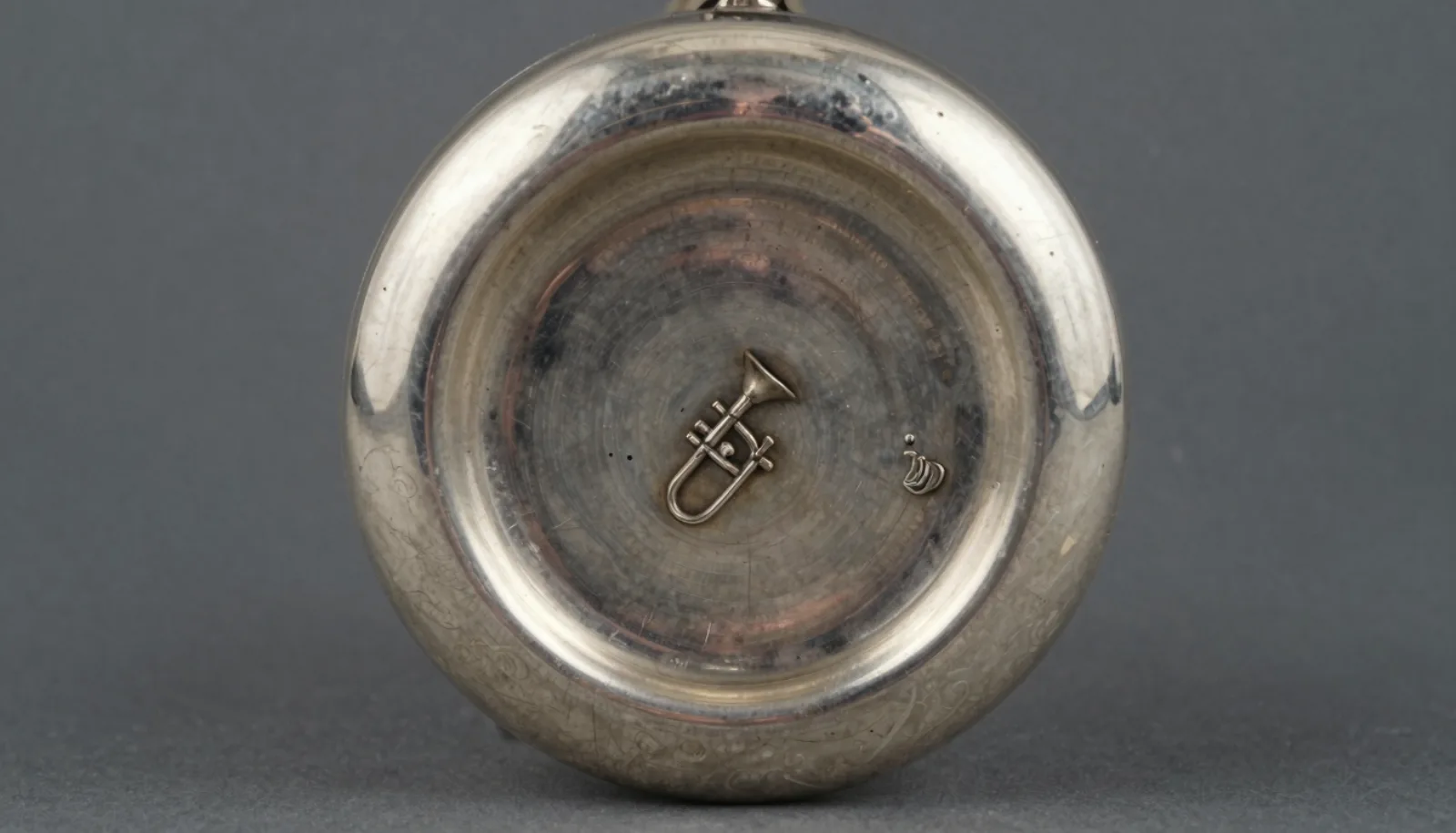
James Dixon and Sons marks span pewter, Britannia metal, electroplate and sterling. The trumpet-and-banner stamp dates a piece to 1879 or later.
Who were James Dixon and Sons?
James Dixon and Sons operated in Sheffield from 1806 until 1992, which is exactly why one maker left behind marks in five different materials. A collector holding a Dixon piece is rarely holding silver. Most surviving output is Britannia metal or electroplate, and the mark on the base tells you which.
The firm began as Dixon and Smith, a partnership between James Dixon and Thomas Smith. Britannia metal was the first product line. It spun quickly on a lathe, polished up bright, and undercut real silver by a wide margin. Sheffield already had the labour and the tooling, so the business grew fast.
Cornish Place, on the River Don, became the works everyone associates with the name. Building started around 1822 and the site expanded for the next century. At its height it employed well over a thousand hands. The buildings survive today as apartments, with the Dixon name still cut into the stone above the entrance.
The “and Sons” in the trading name dates from 1835, when James Dixon brought his sons into the partnership. William Frederick Dixon is the one whose initials matter to collectors. The sterling silver maker’s mark entered at the Sheffield assay office reads JD over WFD, and that punch is the single most reliable Dixon identifier on hallmarked silver.
Sporting goods paid the bills for decades. Dixon supplied powder flasks, shot measures, hunting horns and drinking flasks to the gun trade across Britain and North America. Any seasoned collector knows the sporting line is where the trumpet in the trademark comes from. The firm sold to shooters, so it branded itself with a horn.
Electroplating arrived in the 1840s and rewrote the catalogue. Dixon took up the process and began plating both nickel alloy and its own Britannia metal bodies. From that point the same teapot shape could leave Cornish Place in three grades: unplated Britannia metal, electroplated Britannia metal, and sterling silver. Three prices, three sets of marks, one design.
That layering is the practical problem for anyone identifying a piece today. A Dixon trumpet mark on a teapot base tells you the maker and a rough date, but says nothing about metal content. You need the letters struck beside it. For a wider view of how plated marks differ from assayed ones, the silver plate marks guide covers the whole category.
| Period | Trading name | Main output | How marks read |
|---|---|---|---|
| 1806 to 1823 | Dixon and Smith | Britannia metal, pewter | Incuse capitals on the underside |
| 1823 to 1835 | James Dixon and Co | Britannia metal, Old Sheffield Plate | Name in a straight line or arc |
| 1835 to 1879 | James Dixon and Sons | Plate, Britannia metal, sterling | Full name plus a pattern number |
| 1879 to 1920s | James Dixon and Sons | Electroplate, sterling, sporting goods | Trumpet and banner, often with EPNS or EPBM |
| 1920s to 1992 | James Dixon and Sons Ltd | Electroplate, stainless, sterling | Trumpet mark, sometimes with Ltd |
What does the trumpet and banner mark mean?
The trumpet and banner mark is a bugle with a pennant flying from it, registered by James Dixon and Sons as a trademark in 1879. Its presence dates a piece to 1879 or later. That single fact settles most Dixon dating questions before you examine anything else.
The design nods to the firm’s sporting trade. Dixon built hunting horns and powder flasks for the gun trade, so a horn made commercial sense as a badge. Struck examples show the bell of the trumpet on the left and the banner streaming to the right, usually inside a shaped cartouche around four millimetres across.
Before 1879 the firm marked goods with its name spelled out. You will see JAMES DIXON and SONS in a straight line, in a gentle arc, or inside a plain rectangle. SHEFFIELD often sits below. Pieces carrying the full name and no trumpet are generally pre 1879, although older punches stayed in occasional use for some years after the trademark was adopted.
Three variants of the trumpet punch turn up often enough to be worth learning:
- Trumpet alone with no lettering. Common on small sporting items and flask caps where space is tight.
- Trumpet with JAMES DIXON and SONS arced above or below. The standard hollowware marking from the 1880s onward.
- Trumpet with the firm name plus SHEFFIELD ENGLAND. Export marking, mostly 1891 onward after United States tariff law required a country of origin on imported goods.
That last variant is a genuinely useful date bracket. ENGLAND appearing anywhere on a British plated piece usually means 1891 or later, and MADE IN ENGLAND normally pushes it past about 1920. The rule holds across Sheffield makers, not only Dixon.
Wear patterns tell you something too. On electroplated goods the trumpet punch was struck into the base before plating, so the mark sits under the silver layer. As a base wears, the plate rubs off the high points of the mark first and leaves the nickel showing through the lettering. That is normal and expected. A trumpet mark that looks etched or engraved rather than struck deserves a hard second look, because an original punch displaces metal instead of removing it.
Sheffield’s other big plated houses used comparable pictorial devices. Walker and Hall chose a flag inside a shield, which is easy to confuse with the Dixon banner at a glance across a fair table. The Walker and Hall marks guide sets the two devices side by side. Both firms worked within a mile of each other and competed for the same catalogue trade, so their output turns up in the same house clearances constantly.
How do you tell Dixon pewter from Britannia metal?
Britannia metal is the answer for almost every unplated Dixon piece you will handle. The firm built its business on the alloy from 1806, and true leaded pewter was a minor and mostly early line. Both metals are tin based, so the difference lives in the marks and in how the metal behaves in the hand.
Britannia metal runs roughly 92 percent tin, 6 percent antimony and 2 percent copper. It contains no silver and no lead. Traditional pewter uses lead, which makes it heavier, duller and softer. Tap a Britannia metal beaker and it rings faintly. Tap leaded pewter and it thuds. The Britannia metal entry covers the metallurgy in more detail.
Dixon Britannia marks follow a consistent formula. You get the firm name, sometimes SHEFFIELD, and a number. That number is a pattern reference from the trade catalogue. It is not a date and it is not a purity figure. Numbers run from two digits into the thousands as the catalogue grew across the nineteenth century. Two teapots of the same shape carrying different numbers usually differ in a detail such as handle style or spout profile.
Some Britannia pieces add a capacity mark instead: PINT, QUART, HALF PINT. Tankards and measures carry these. On tavern measures you may also find an imperial verification stamp, a crown over a number, applied by a local inspector of weights and measures. That stamp is not a Dixon mark, and its number identifies the district rather than the year.
Early pewter from the Dixon and Smith years is scarce. When it appears it carries the partnership name in incuse capitals, with no trumpet and no pattern number. Anything showing a trumpet cannot belong to that era, since the trademark postdates the partnership by more than seventy years.
The practical test at a fair takes ten seconds. Look for a seam first. Britannia metal hollowware was spun and soldered, so a horizontal join often runs around the body. Cast pewter shows no such seam. Then check the base colour where wear has broken through any surface finish. Britannia metal shows grey white underneath, plated copper shows warm pink, and plated nickel shows a colder grey yellow.
Collectors sometimes assume unplated Britannia metal is worthless. It is not quite that simple. Plain Victorian Britannia teapots sit at ten to thirty dollars, but a Dixon Britannia coffee pot with a crisp Regency profile and legible marks can reach eighty to one hundred and fifty. Form and condition drive that gap, not the alloy.
Reading Dixon electroplate marks: EPNS, EPBM and quality codes
EPNS and EPBM are the two letter groups that decide what a Dixon plated piece actually is. EPNS means electroplated nickel silver, where the base is a copper nickel zinc alloy. EPBM means electroplated Britannia metal, where the base is the tin alloy the firm had used since 1806. Neither contains sterling silver beyond the plated skin.
The distinction matters for money and for repair. Nickel silver bases take replating well and survive heavy use. Britannia metal melts at a much lower temperature, so a plater has to work carefully and some refuse the job outright. A Dixon EPBM teapot with worn plate is often not worth restoring, while an EPNS tray of the same age usually is.
Dixon plated marks combine the trumpet with letters and numbers in a predictable row. A typical base reads: trumpet punch, then JAMES DIXON and SONS, then EPBM, then a pattern number. Some pieces add a letter code for plate thickness. Others carry A1, the trade shorthand for the firm’s best standard of deposit. The A1 and A2 quality numbers guide explains what those codes did and did not promise a buyer.
Watch for pseudo hallmarks. Sheffield plate makers of the period liked to strike a row of small shaped punches echoing the look of assayed silver: a crown, a shield, a letter in a lozenge. Dixon used them on some lines. They carry no legal meaning and no assay office ever saw the piece. Real British hallmarks arrive as a set of four or five marks including a lion passant, and a plated piece can never legally carry a lion passant.
| Feature | EPNS, nickel silver base | EPBM, Britannia metal base |
|---|---|---|
| Base alloy | Copper, nickel, zinc | Tin, antimony, copper |
| Colour under worn plate | Cold grey yellow | Grey white |
| Weight for the same form | Heavier | Lighter |
| Replating prospects | Straightforward | Difficult, low melting point |
| Typical Dixon use | Trays, cutlery, entree dishes | Teapots, coffee pots, tankards |
| Resale strength | Moderate | Weak |
Elkington held the founding electroplating patent from 1840 and licensed it across the trade. Dixon plated within that system like most of Sheffield. The two firms marked very differently though, because Elkington ran a true date letter cycle on its plate. That system pins an Elkington piece to a single year, which no Dixon plated mark will ever do. The Elkington date letter guide sets out the full cycle.
For a Dixon plated item you are dating by style, by the presence or absence of the trumpet, and by whether ENGLAND appears. That yields a bracket of ten to twenty years rather than a single year. The wider EPNS marks reference covers the mark vocabulary shared across Sheffield platers, which helps when a base carries punches from more than one supplier.
Not sure what you’ve got?
Snap a photo and let our AI identify any antique in seconds, free and with no sign-up.
Identify on iPhone →Learn MoreWhich Sheffield hallmarks appear on Dixon sterling silver?
A genuine Dixon sterling piece carries four struck marks, and the maker’s punch reads JD over WFD in a shaped shield. The other three are the Sheffield town mark, the lion passant for sterling standard, and a date letter. Miss any of those and you are almost certainly holding plate.
Sheffield’s town mark was a crown from 1773 until 1974. From 1975 the office switched to a Tudor rose, so a crown gives you an immediate pre 1975 bracket. The lion passant, a lion walking left with its right forepaw raised, certifies 925 parts per thousand. Both punches are tiny, often under two millimetres, and both wear badly on flatware handles.
The JD over WFD punch was entered at Sheffield in the 1860s and stayed in service for decades. Earlier Dixon silver can show different initial combinations as partners changed. Later twentieth century pieces sometimes use a simplified JD and S punch. When the maker’s mark is rubbed beyond reading, the town mark and date letter still identify the office and the year, and the UK hallmarks guide walks through reading a worn set.
Sheffield date letters run in cycles of roughly twenty five letters, with shield shape and letter case changing between cycles. That is how you separate an 1890 F from a 1957 F. Reading the shield outline matters as much as reading the letter itself. Assay office charts reproduced by Kovels show the full sequences with their shield shapes.
Dixon sterling output concentrated on smaller goods. Hip flasks, christening mugs, napkin rings, vesta cases, cigarette cases, sugar tongs and dressing table pieces come up regularly at general sales. Large sterling hollowware from Dixon is comparatively scarce, because the firm’s volume business was always plate.
Hip flasks deserve their own note. Dixon made them in three grades at once: nickel plated, sterling, and sterling under a leather or shagreen cover. Sterling versions are fully hallmarked on the body and often again on the cap. A flask marked only with a trumpet and EPNS is the plated grade, worth a fraction of the hallmarked one. Checking both the body and the bayonet cap is worth thirty extra seconds, since caps get swapped between flasks and a mismatched pair loses value.
Museum catalogues are the cheapest reference available for punch shapes. The Metropolitan Museum and the Victoria and Albert Museum both hold Sheffield silver of this period, photographed at a resolution that lets you compare a shield outline against the piece in your hand.
What is a James Dixon and Sons piece worth?
Most James Dixon pieces sell between twenty and three hundred dollars, and the exceptions are almost all Christopher Dresser designs. The maker name on its own adds modest value. Material, form and condition do the real work, and a trumpet mark by itself is not a premium signal.
Plated hollowware sits at the bottom of the market. Tea services, muffin dishes and entree dishes in EPBM change hands cheaply because supply is enormous and demand for formal serving pieces has fallen hard since the 1990s. Worn plate showing base metal drops the figure further, since replating a Britannia body is difficult and often uneconomic.
Sporting goods hold up much better. Dixon powder flasks have a dedicated collector base in the United States, driven by the muzzle loading community rather than by silver collectors. Copper flasks with embossed hunting scenes and a clean Dixon stamp are steady sellers. Damage to the charger spout hurts value more than dents to the body, because the charger is the mechanism.
| Item | Material and period | Typical condition | Recent range |
|---|---|---|---|
| EPBM teapot | Plated, 1880 to 1910 | Plate worn on spout and foot | 25 to 70 dollars |
| Entree dish with cover | EPNS, 1890 to 1920 | Sound plate, minor scratches | 60 to 180 dollars |
| Copper powder flask, hunting scene | Copper and brass, 1840 to 1880 | Working charger, honest patina | 120 to 400 dollars |
| Sterling hip flask, leather covered | Sterling, 1890 to 1915 | Full hallmarks, sound leather | 250 to 650 dollars |
| Sterling christening mug | Sterling, 1880 to 1910 | Engraved name, no splits | 150 to 350 dollars |
| Sterling vesta case | Sterling, 1890 to 1910 | Crisp marks, working hinge | 120 to 300 dollars |
| Dresser toast rack | Plated, 1880 to 1882 | Original, marked, undamaged | 2,000 to 9,000 dollars |
| Dresser teapot, scarce model | Plated or silver, 1879 to 1882 | Documented model number | 20,000 dollars and up |
Those ranges reflect auction results and dealer asking prices across recent years rather than a fixed price list. Sold listings on WorthPoint give a more current picture than any printed guide, because the plated market moves with interior fashion rather than with metal prices.
One warning about weight. Plated hollowware is often heavier than sterling of the same form, because the base metal is made thicker to compensate for softness. Buyers who assume heft equals silver overpay regularly at general sales. Reading the mark takes seconds and settles it, and the five visible differences between EPNS and sterling covers the checks that work without tools.
Provenance shifts the numbers on institutional pieces. Dixon supplied hotels, railway companies and shipping lines, and plate carrying a company crest alongside the trumpet mark trades to a separate collector group. A crested ship’s teapot can outsell an identical uncrested one several times over, purely on the strength of the badge.
Why do Christopher Dresser designs break records?
Christopher Dresser designed for James Dixon and Sons between roughly 1879 and 1882, and those three years produced the most valuable objects the firm ever made. A Dresser teapot in a scarce model can reach a six figure sum at auction. An ordinary Dixon Victorian teapot from the next bench sells for the price of a sandwich.
Dresser trained as a botanist and worked as an independent industrial designer, which was an unusual role in 1879. His Dixon pieces strip ornament away completely. Geometric bodies, ebony handles set at hard angles, exposed rivets and flat planes. They look like objects from 1930 rather than 1880, which is precisely why the design world rediscovered them in the 1970s and never let go.
Identifying a Dresser Dixon piece rests on three things:
- The form. Nothing else Dixon made looks remotely like it. Conical, cubic or hemispherical bodies with no engraved decoration whatsoever.
- The registered design number or model number struck on the base alongside the standard Dixon marks.
- A facsimile Dresser signature on some examples, reading Chr Dresser, though plenty of genuine pieces carry no signature at all.
The absence of a signature does not disqualify a piece. Model numbers in the 2200 to 2300 range cover several of the documented teapot designs. Reference photographs matter more than any single mark here, and the Victoria and Albert Museum holds documented examples that serve as the comparison standard for the whole category.
Reproductions exist and they are a real problem for buyers. Alessi produced authorised reissues of Dresser designs from the 1990s, clearly marked with modern maker names. Unauthorised copies also circulate, usually betrayed by soft casting detail, wrong proportions and modern screw fixings. A period Dixon piece shows plating wear consistent with its age, plus struck rather than cast marks.
The market splits cleanly in two. Dresser toast racks and cruet frames survive in larger numbers and trade in the low thousands. Teapots in the scarcest models are the headline lots, and only a handful reach the open market in any decade. Everything else Dixon made trades on ordinary antique silver logic, where maker matters less than form and condition.
For collectors working through a box of mixed Sheffield items, the sensible order is metal first, maker second, designer last. Establish whether it is plate or sterling, then read the maker punch, then ask whether the form is unusual enough to warrant research. The silver makers marks index is the place to start on the second step.
Frequently Asked Questions
Is there an app that reads James Dixon and Sons marks from a photo?
Antique Identifier – Antiqly reads the trumpet and banner punch together with the letters struck beside it, which is the exact pairing that decides whether a Dixon piece is plate or sterling. Point the camera at the underside in raking light and Antiqly returns the maker, a likely date bracket and a plate or sterling reading. The download is free and no account is required before the first identification. It is strongest on struck maker punches and British assay marks, which covers most Sheffield output. Badly rubbed marks still reward a loupe and a printed chart, so treat any photo result as a fast first opinion rather than a final verdict.
What does the trumpet mark on James Dixon silver mean?
The trumpet and banner is the registered trademark of James Dixon and Sons, adopted in 1879. It shows a bugle with a pennant flying from the bell, usually inside a small shaped cartouche. Its presence dates the piece to 1879 or later, which is the most useful thing any single Dixon mark tells you. The device refers to the firm’s long trade in hunting horns and powder flasks. It appears on electroplate, on Britannia metal and occasionally alongside full hallmarks on sterling. The trumpet identifies the maker only. It says nothing about metal content, so always read the letters struck next to it before deciding what you have.
How do I tell if my James Dixon piece is real silver?
Look for a full set of four struck hallmarks: a crown for Sheffield before 1975, a lion passant for sterling standard, a date letter in a shaped shield, and the maker’s punch reading JD over WFD. All four must be present. If you see EPNS, EPBM, A1 or the word PLATE anywhere on the base, the piece is electroplated and the silver is a surface layer measured in microns. A trumpet mark with no lion passant means plate every time, because British law never permitted a lion passant on plated goods. Where wear has taken the marks, check for pink copper or grey nickel showing through at the rim, handle and foot, since those are the first points to lose plating.
What does EPBM mean on a James Dixon teapot?
EPBM stands for electroplated Britannia metal. The body is Britannia metal, a tin alloy of roughly 92 percent tin with antimony and copper, given a thin electroplated silver coating. Dixon used the marking heavily on teapots, coffee pots and tankards because Britannia metal spins easily into hollow shapes. It is not sterling and it holds no bullion value. EPBM matters practically because Britannia metal has a low melting point, which makes replating awkward and expensive relative to the value of the finished object. A worn EPBM teapot is usually worth twenty five to seventy dollars, and restoration rarely returns the cost. EPNS pieces on a nickel base replate far more successfully.
When did James Dixon and Sons stop trading?
The Cornish Place works in Sheffield ceased production in 1992, closing a run that began in 1806. Output changed shape considerably in the final decades. Stainless steel cutlery and hotel ware replaced most of the electroplated hollowware that had carried the firm through the Victorian and Edwardian periods. The Cornish Place buildings were converted to residential apartments in the late 1990s and still carry the Dixon name in stone. For dating purposes the closure gives you a hard ceiling: nothing genuine carries a Dixon mark after 1992. In practice the marks you meet most often are Victorian and Edwardian, since that is when the firm produced at its highest volume.
Are James Dixon powder flasks worth collecting?
Dixon powder flasks are among the firm’s stronger performers, typically 120 to 400 dollars for a copper flask with an embossed hunting scene, a legible Dixon stamp and a working charger. The buyers are muzzle loading shooters and arms collectors rather than silver people, which keeps that market largely independent of the plated silver slump. Condition priorities differ from silver too. A functioning charger and intact spring matter more than surface dents, since dents read as honest use while a broken charger reads as a repair job. Rarer patterns, presentation flasks and examples with original leather cases sit well above the standard range. Reproduction flasks exist, usually giving themselves away through soft casting detail.
Identify any antique in seconds.
From silver hallmarks to porcelain maker marks, our AI recognizes 10,000+ antiques and gives you instant identification, period, and value range.
Download Free on iPhoneSee How It Works