
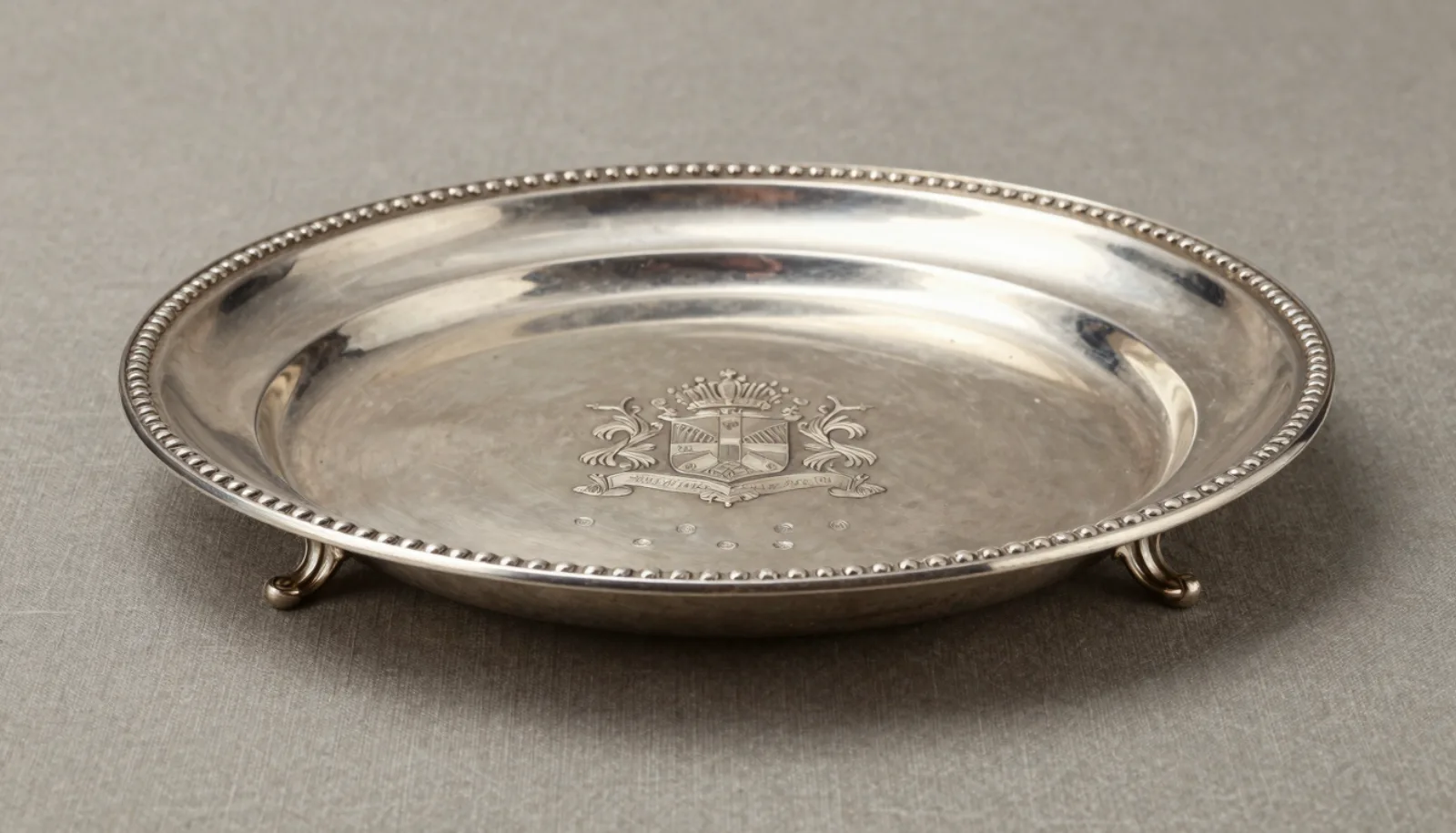
Most antique silver trays sell for £60 to £6,000. Sterling or plate, size, and maker set the band; large Georgian tea trays hold the top.
Sterling or silver plate: the first value split
A sterling tray is typically worth ten to fifty times more than a plated tray of the same size. Settle this one question before you think about maker or date. Every other value factor sits downstream of it.
British sterling trays carry a hallmark row: a lion passant for 925 purity, a town mark, and a date letter. The lion passant confirms sterling in England. Scottish trays show a thistle or a lion rampant instead. Find the row on the underside, near the rim or between the feet.
Plated trays announce themselves with letters, not symbols. EPNS stands for electroplated nickel silver. EP, A1, EPBM, and the words ‘silver plate’ all mean a base-metal body under a thin silver skin. Elkington & Co. patented the electroplating process in 1840, and Sheffield and Birmingham firms stamped these letter codes for the next century.
Your hands can check what the stamps claim. Run a fingertip over the high points of the border. Worn plating breathes through as a warm pink where the base is copper, or a cold grey where it is nickel. Sterling wears to sterling; it never changes colour at the rubs. Any seasoned collector checks the rim before reaching for a loupe.
Old Sheffield Plate complicates the picture. Fused plate made between roughly 1745 and 1850 carries no statutory hallmarks at all. Makers sometimes struck small pseudo-marks that imitate a hallmark row at a glance. A fine copper line where the silver sheet folds over the rim gives these trays away. Collectors still pay for good Old Sheffield Plate, and a crested example can outsell a plain Victorian sterling waiter.
One caution on wishful reading: ‘925’ struck alone, with no lion or town mark, appears on modern imports and on some fakes. Treat a lone 925 as a claim to verify, not a verdict. Our silver marks guide walks through each symbol in the row and what must accompany it.
What are antique silver trays worth?
Typical auction bands run from under £100 for plated trays to £2,000-£6,000 and beyond for large Georgian tea trays. The table below reflects what ordinary examples bring at general and specialist sales. Exceptional makers, documented provenance, or rare forms sell above every figure here.
| Tray type | Typical auction band | What moves it within the band |
|---|---|---|
| EPNS or electroplated tray | £20-£120 | Maker (Elkington, Walker & Hall), plating condition, pierced gallery border |
| Sterling waiter, 6-8 in | £80-£250 | Weight, crisp hallmarks, armorial engraving |
| Sterling salver, 10-12 in | £250-£700 | Georgian vs later date, gauge, border style |
| Large sterling salver, 14-16 in | £600-£1,500 | Weight above 1 kg, maker, original surface |
| Two-handled sterling tea tray, Victorian or Edwardian | £800-£2,500 | Weight (often 2-3 kg), maker, condition of handles |
| George III two-handled tea tray | £2,000-£6,000+ | Maker (a first-rank name multiplies this), armorials, weight |
| American sterling tray (Gorham, Tiffany) | $300-$3,000 | Pattern, weight, retailer marks, date symbols |
Read the bands as floors and ceilings for ordinary pieces, not promises. Two trays with identical catalogue descriptions diverge on weight and surface alone. A 12-inch salver at 550 g and another at 900 g settle in different worlds.
Melt value sets the hard floor under every sterling band. No sterling tray should sell below its silver content for long, because dealers close that gap quickly. The next section shows the arithmetic in one worked example.
Placing your own tray starts with the marks, since the maker and date decide which band applies. For turning a photographed hallmark row into an identification and a band for your exact piece, see which hallmark reader apps handle trays best; the comparison covers free and paid options honestly.
Why does size move the band so much?
Size sets weight, and weight sets the melt floor under every sterling tray. A tray is mostly a flat sheet of silver, so metal content climbs with the square of the diameter. A 16-inch salver holds roughly four times the silver of an 8-inch waiter, before cast feet and borders add more.
The melt arithmetic takes one minute. Weigh the tray in grams. Multiply by 0.925 for sterling fineness. Divide by 31.103 to convert to troy ounces. Multiply by the day’s spot price.
Worked example: a Victorian 12-inch salver weighs 800 g. Fine silver content is 800 x 0.925 = 740 g, which is 23.8 troy ounces. At a spot price of $45 per troy ounce, the metal alone is worth about $1,070. Spot moves daily, so rerun the last step on the day you act; our melt value walkthrough covers the method for every purity standard.
Gauge matters as much as diameter. Georgian silversmiths worked heavier sheet, and a George III salver feels dense and rigid in the hand. Press the centre of a thin Edwardian example and it flexes with a faint oil-can pop. Buyers pay for that Georgian stiffness, and the weight lines in auction catalogues show why weight is quoted before anything else.
Handles change the category and the band. Once a maker added two cast handles, the piece became a tea tray, built to carry a full service. Complete sterling tea trays commonly weigh 2,000-3,500 g. At those weights the melt floor alone can pass £1,500, which is why no honest Georgian tea tray ever sells cheap.
Feet count in the weight and in the story. Salvers stand on three or four cast feet; check each one for solder shadows, because a re-attached foot drops a tray toward the bottom of its band.
Not sure what you’ve got?
Snap a photo and let our AI identify any antique in seconds. Free, no sign-up.
Identify on iPhone →Learn MoreMakers that lift a tray above its band
A first-rank maker’s mark can multiply a tray’s value by five or more against an identical anonymous example. Auction buyers bid the initials first and the object second. A short list of names does most of the lifting for trays.
| Maker | City and period | Mark to look for | Effect on tray value |
|---|---|---|---|
| Paul de Lamerie | London, 1713-1751 | PL below a crown | Museum territory; salvers reach five and six figures |
| Hester Bateman | London, 1761-1790 | HB in script | Strong collector premium on waiters and salvers |
| Matthew Boulton | Birmingham, 1773-1809 | MB | Premium; the founding name of Birmingham assay |
| Paul Storr | London, 1792-1838 | PS | Top of the Regency market; heavy salvers excel |
| Elkington & Co. | Birmingham, 1840 onward | E&Co with date code | The premium name in electroplate |
| Walker & Hall | Sheffield, 1845 onward | W&H beside a flag | Modest lift; strongest in plate |
| Mappin & Webb | Sheffield and London, 1863 onward | M&W | Reliable mid-market lift in sterling and plate |
| Gorham | Providence, 1831 onward | Lion, anchor, G | Leads the American market with Tiffany |
| Tiffany & Co. | New York, 1837 onward | TIFFANY & CO. with STERLING | Strong, pattern-driven premiums |
Match the initials to the town mark and date letter, never alone. Several London makers shared initials across the centuries, and the date letter separates them. Attribution built on initials without a date is guesswork.
Museum collections calibrate the top of the market. The Victoria and Albert Museum displays Paul Storr’s work in its silver galleries, and the Metropolitan Museum of Art holds Gorham and Tiffany silver in its American Wing. Seeing the gauge and finish of these pieces explains what five-figure bidders are paying for.
Elkington deserves a special note for plated trays. Elkington & Co. stamped its own date codes on electroplate, so an Elkington tray can be dated to the year even though it carries no statutory hallmarks. Dated plate consistently outsells undated plate.
How do you date a silver tray from its hallmarks?
The date letter in the hallmark row pins a British tray to a single year. Each assay office ran its own alphabet cycles, changing the letter every year and the shield outline and font with each new cycle. Read the letter against the correct office’s table, never a generic chart.
Start with the town mark. London strikes a leopard’s head. Birmingham strikes an anchor. Sheffield struck a crown until 1975 and a rose after. Our UK hallmarks guide holds each office’s date letter tables and shield outlines.
A sovereign’s head duty mark brackets the date on its own. The duty mark appeared in 1784 and disappeared in 1890, so its presence places a tray inside that window before you open a single table. Collectors pay a small extra premium for the incuse duty punch used only from 1784 to 1786, which makes those first strikes worth confirming.
Boundary cases catch people out. American sterling trays carry no date letter at all; Gorham stamped year symbols from 1868, and Tiffany used pattern and order numbers, so a missing letter does not mean plate. Old Sheffield Plate carries no statutory marks either. Plated wares often imitate a hallmark row with four small pseudo-stamps, and a row without a lion passant proves nothing about purity.
Terminology helps when you read catalogue entries. A salver stands on feet and has no handles. A waiter is a small salver, under about eight inches. A tea tray carries two handles. Auction houses price the three forms differently, so the word chosen in a description is itself a value signal.
Photograph the row before you consult any table. Side light at a low angle raises worn punches that overhead light flattens. A phone photo you can zoom into beats a loupe for tired eyes, and it gives you a record to compare against reference tables at leisure.
Details that add value, and details that cut it
Original armorial engraving adds value; later erasure destroys it. That single rule explains most of the surprises in tray results.
A period coat of arms, crisply cut in the centre, documents the tray’s first owner and proves the surface survives intact. Buyers pay for armorials. A single later monogram sits closer to neutral. Removal is what kills: polishing out an old inscription thins the centre, and the metal never recovers.
Catch an erasure in raking light. Hold the tray flat toward a window and look across the centre; an erased cartouche shows as a shallow dull hollow with a faint orange-peel texture. Press gently underneath as well, since thinned centres flex first. Dealers describe such trays as ‘breathed on’, and they trade at steep discounts.
Presentation inscriptions divide the market. ‘To Dr. Jones from the grateful Parish, 1897’ subtracts from an ordinary tray, because the next owner is buying a stranger’s story. An inscription tied to a documented event or a recognisable name adds instead. The buyer logic matches what we set out in what a hallmark is worth to a buyer: documentation sells, anonymity discounts.
Borders and galleries need their own inspection. A pierced gallery looks impressive, but galleries split at the corners, and a competent repair still shows from the back. Cast pie-crust borders hide damage better than flat rims, so tilt the tray under light and follow the edge the whole way round.
Condition rules run consistently across small silver. Solder repairs at the feet, split rims, and machine-buffed surfaces all push a tray to the bottom of its band. The same drivers govern the smaller table pieces we have covered, from salt cellars to napkin rings; trays obey the same physics with more metal at stake.
Selling an antique silver tray: pick the route by band
Match the selling route to the tray’s band: online sale under £300, specialist silver auction above £600, and a melt comparison only for damaged sterling. The wrong route costs more than any commission.
| Your tray | Best route | Why |
|---|---|---|
| Plated tray, any condition | Online marketplace or house-clearance lot | Sits below most auction minimum lot values |
| Sterling waiter or small salver, under £300 band | General auction or direct dealer sale | Fees stay proportionate at this level |
| Heavy salver or tea tray, £600 and up | Specialist silver sale, regional or London | Silver-sale bidders pay for weight and names |
| First-rank maker (Storr, Bateman, de Lamerie) | Named silver auction, after research | The name needs the right room; take two estimates |
| Damaged or erased sterling | Dealer offer checked against melt | Melt is the honest floor; some damage erases all premium |
| American maker (Gorham, Tiffany) | US auction or a pattern-matching dealer | Pattern collectors outbid generalist rooms |
Check realised results before accepting any estimate. WorthPoint archives marketplace results searchable by maker and form, and Kovel’s publishes price guides that place a tray beside comparable pieces. Real hammer results beat any formula, including the bands in this article.
Timing matters less than sellers hope. Silver sells year-round, and weight plus condition decide far more than the season. Put the effort into identification instead: a tray consigned with its maker named and its date read has already earned most of its premium.
Keep the paperwork with the piece. An old receipt, a family note, or an insurance schedule entry travels with the tray and reassures the next buyer. Provenance on paper costs nothing to keep and consistently helps at settlement.
Frequently Asked Questions
Is there an app that can identify a silver tray’s marks and value band?
Antique Identifier – Antiqly reads a photographed hallmark row on a tray’s base and identifies the standard mark, town mark, date letter, and maker. Photograph the punches in low side light and the app returns the assay office, the year, and a value band for the piece. The download is free and no sign-up is required. Antiqly handles worn rows better than a general image search because it matches against hallmark reference tables rather than the whole photograph, which is exactly what a rubbed tray base needs.
Are silver-plated trays worth anything?
Most plated trays trade between £20 and £120, and many bring less at general sales. Exceptions exist. Elkington & Co. trays with clear date codes, large pierced-gallery trays in strong condition, and crested Old Sheffield Plate all beat the generic band. Old Sheffield Plate is the sleeper: fused plate made before about 1850 has its own collector market, and a good crested example can outsell a plain sterling waiter. Condition decides everything in plate, because worn plating cannot be built back without destroying originality. Once the copper shows across the whole surface, the tray is decorative rather than collectable.
Does a monogram or coat of arms change a tray’s value?
A period coat of arms adds value; a later erasure subtracts far more than any engraving would. Armorials document the original owner and prove the centre has never been polished away. A single Victorian monogram sits close to neutral on an otherwise good tray. Erasure is the real damage: removing an inscription thins the metal, leaves a dull hollow visible in raking light, and can cut a result by a third or more. Leave old engraving alone. Buyers who dislike a monogram still pay more for honest metal than for a thinned, blank centre.
How do I work out the melt value of a sterling tray?
Weigh the tray in grams, multiply by 0.925, divide by 31.103, then multiply by the day’s silver spot price. An 800 g salver holds 740 g of fine silver, which is 23.8 troy ounces; at $45 per ounce that is roughly $1,070. Spot changes daily, so recalculate on the day you sell. Treat melt as a floor, not a valuation: hallmarked Georgian and maker-marked trays carry premiums well above metal, and scrapping such a piece destroys that premium permanently. Use the melt figure mainly to sanity-check a low dealer offer.
What is the difference between a salver, a waiter, and a tray?
A salver is a flat, footed serving piece without handles. A waiter is a small salver, generally under eight inches across. A tea tray carries two handles and was built to bear a full tea service. The distinction matters for value because the forms occupy different bands: waiters commonly bring £80-£250, salvers £250-£1,500 depending on size and date, and complete sterling tea trays start around £800 on weight alone. Auction catalogues use the three terms precisely, so the word in a listing signals the band the house expects before you read the estimate.
Why do two similar-looking trays sell for very different amounts?
Weight, maker, and surface separate look-alike trays. Two 12-inch salvers can differ by 350 g, which moves the melt floor and signals gauge quality. A recognised maker’s mark multiplies value against an anonymous equivalent of the same date. Surface tells the rest: crisp original engraving and soft hand-polished patina beat a machine-buffed shine, and an erased centre discounts heavily. Hallmark clarity itself carries money, since a fully legible row dates and attributes the piece without argument. Read the underside first and auction results stop looking random.
Identify any antique in seconds.
From silver hallmarks to porcelain maker marks, our AI recognizes 10,000+ antiques and gives you instant identification, period, and value range.
Download Free on iPhoneSee How It Works