
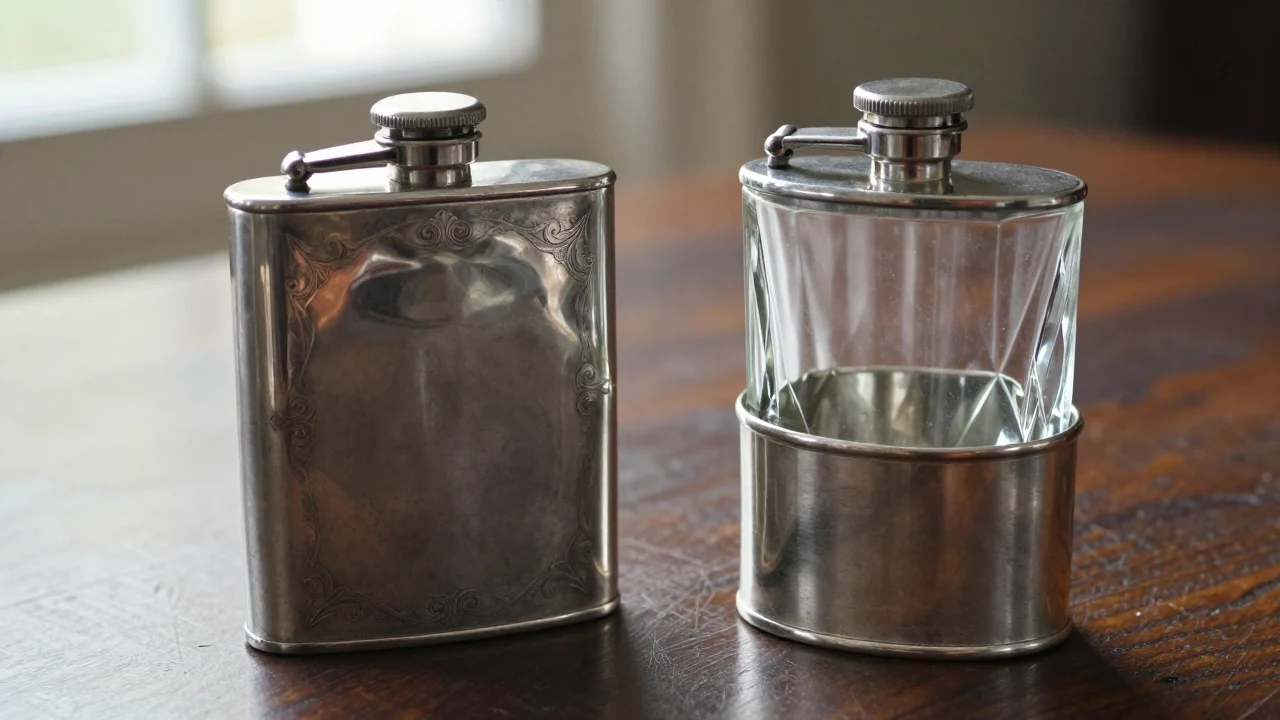
Antique silver hip flasks sold alone made £70 to £400 hammer at Toovey’s from January 2024 to August 2026; all-silver flasks mostly outsold glass ones.
Every price in this guide is a published auction result with its sale date and lot page linked, so you can set your own flask beside one that actually changed hands. All results come from one saleroom, Toovey’s, whose lot pages print the hammer price and state that all sold prices shown exclude Buyer’s Premium. Many flasks sell in mixed lots with scent bottles, snuff boxes or a second flask, so the table holds only the fifteen lots whose sole item was one hallmarked hip flask, and every group lot is described separately in prose. No figure is a dealer’s asking price, and none is the net amount a seller took home.
What is an antique silver hip flask?
An antique silver hip flask is a small flattened bottle for spirits, usually with a screw or hinged lid and often a detachable cup, made to travel in a coat or hip pocket. The form is older than the name. The V&A holds a silver spirit flask of about 1690 whose base is formed as a detachable beaker with gilt interior, and the museum notes that the term ‘spirit flask’ appears to have been coined in 1829. The V&A catalogues that early flask as unmarked, ca. 1690, so a hallmark is not the only evidence a flask can carry, but every flask in the Toovey’s results below is Victorian or later.
The Victorian period is when the hip flask became a common shop item. The V&A’s record for a York spirit flask of 1840-1 states that spirit flasks in silver or glass cased with silver were popular in the Victorian period, and adds that in 1897 Mappin Brothers sold a variety of travelling flasks costing between 13s 6d and £5 10s for solid silver with a cup. Those are 1897 retail prices, not modern values. The single flasks in the table below run from 1866 to 1935.
What are the two main kinds of silver hip flask?
Antique hip flasks come in two kinds: all-silver flasks, and glass flasks with silver mounts, and the two sell at different levels. An all-silver flask is a hollow silver body with a hinged or screw lid; Toovey’s catalogues these by total weight, such as the Edinburgh 1879 oval flask at 155.8g. A glass flask has a cut glass body, sometimes covered in leather or crocodile skin, with a silver neck mount and a detachable silver cup over the base. For these the catalogue gives the weight of the cup only, because the glass cannot be weighed as silver.
Lids tell you how a flask was meant to be used. The catalogue names screw hinged lid for lids that screw down and stay attached, rotating hinged lid for lids that turn on a hinge, and a plain screw lid with cork insert and fitted with a chain on the older Victorian flasks. Check that the lid seals and that the cork or washer is present, because a flask that leaks can no longer be used for spirits.
Where are the hallmarks on a hip flask?
Look for the hallmarks on the body, base and lid of an all-silver flask, and on the silver neck mount and detachable cup of a glass flask, the only silver parts it has. This site’s silver marks guide lists what to find: the maker’s mark, the standard mark, the assay office mark, and the date letter. The Goldsmiths’ Company hallmarking page explains that the first mark is the Sponsor’s or Maker’s Mark, and that the office marks are a leopard for the London Assay Office, an anchor for the Birmingham Assay Office, a rose for the Sheffield Assay Office, and a castle for the Edinburgh Assay Office.
On a glass flask the cup and the mount can carry different years, and that is normal. Toovey’s catalogued one flask as London 1891 and 1893 and a Dixon flask as Sheffield 1921 and 1922, most likely because the parts were assayed in different years. Two different makers on the cup and the mount, or a plated cup on a silver mount, can mean a later marriage of parts: Toovey’s notes a flask fitted with a plated detachable cup in one group lot.
A retailer’s stamp is not a hallmark. The V&A’s Asprey flask of about 1914 has impressed marks for Asprey of London, reading ‘A&Co / Asprey / London’, and the museum notes that the flask appears to have been engraved between March 1908 and June 1916, while its owner was a captain, rather than from any date letter. Photograph every mark in raking light, then read the date letter against a chart for the office shown before you trust a period printed on any label.
How do you date a silver hip flask?
A British hip flask is dated by its date letter, and the sovereign’s head duty mark narrows the period before you read it. As this site’s duty mark guide explains, it vanished in 1890, when the Customs and Inland Revenue Act abolished the duty. The V&A’s York flask shows the pre-1890 set in full: Maker, duty, sterling, York town mark, date letter for 1840-1. A Victorian flask in the table, such as the London 1868 flask or the Birmingham 1866 cigar flask, should therefore show a sovereign’s head beside its date letter; a flask with a Victorian style but no duty mark is consistent with 1890 or later.
The catalogue’s reign words are a guide, not proof. Toovey’s opens each entry with a reign label such as An Edwardian silver mounted faceted cut glass hip flask, but the date letter is what fixes the year. Read it yourself against the chart for the office mark you found.
Who made antique silver hip flasks?
London, Birmingham, Sheffield and Edinburgh makers all appear in Toovey’s flask lots, and one Sheffield firm appears more than any other. James Dixon & Sons is named on a Sheffield 1891 glass flask, the 1921 and 1922 leather flask, a 1922 crocodile skin flask, a large 1927 flask cup and a plated flask. This site’s James Dixon and Sons marks guide explains why: Dixon supplied powder flasks, shot measures, hunting horns and drinking flasks to the gun trade, and the same guide warns that most Dixon output is plate rather than silver, so read the letters beside the trumpet mark.
G. & J.W. Hawksley of Sheffield made three of the flasks, the 1901 oval flask (catalogued with the misspelling Hawskley), the 1909 leather-covered glass flask and the 1925 leather and glass flask. Birmingham names include Colen Hewer Cheshire, George Unite, Charles S. Green & Co Ltd and the partnership of Saunders & Hollings. London supplied Atkin Brothers, Charles Henry Dumenil, Stewart & Fanshaw and two firms better known for other work: Drew & Sons, whose gold-mounted glass flask has a 15ct gold cover, and Sampson Mordan & Co, whose novelty flask is in the form of a tube of paint. Edinburgh appears once, with Hamilton, Crichton & Co.
What is an antique silver hip flask worth?
A single antique silver hip flask made between £70 and £400 hammer at Toovey’s from January 2024 to August 2026, and the kind of flask set most of the difference. All-silver flasks made £120 to £400, while silver-mounted glass flasks made £70 to £280. Buyers pay the premium on top of each hammer price.
| Flask type | Hammer range, single lots | What set the price |
|---|---|---|
| All-silver flask (8 lots) | £120 to £400 hammer | Age and fittings such as a cigar compartment |
| Silver-mounted glass flask (7 lots) | £70 to £280 hammer | Gold or silver gilt mounts and an earlier date |
| Mixed lots and flask parts (10 lots) | £110 to £360 per whole lot | The other items in the lot, never the flask alone |
The fifteen single-flask results, highest first within each kind:
| Flask | Catalogued detail | Hammer result |
|---|---|---|
| Birmingham 1866, Colen Hewer Cheshire | All silver, cigar compartment, 341.9g | Hammer price: £400, 30 October 2024 |
| Edinburgh 1879, Hamilton, Crichton & Co | All silver, oval, detachable cup, 155.8g | Hammer price: £220, 3 December 2025 |
| London 1871, Thomas Johnson I | All silver, engine turned, 124g | Hammer price: £220, 14 May 2025 |
| London 1899, Sampson Mordan & Co | All silver novelty flask with stamp box, 47.9g | Hammer price: £180, 5 November 2025 |
| London 1912, Stewart & Fanshaw | All silver, engraved inscription, 169g | Hammer price: £160, 5 August 2026 |
| London 1868, no maker catalogued | All silver, cork-lined screw lid on a chain, 109.2g | Hammer price: £140, 3 December 2025 |
| Birmingham 1935, Charles S. Green & Co Ltd | All silver, engine turned, inscribed lid, 135.3g | Hammer price: £140, 19 March 2025 |
| Birmingham 1918, Cornelius Desormeaux Saunders & James Francis Hollings | All silver, curved rectangular, 76.5g | Hammer price: £120, 27 November 2024 |
| London 1890, Drew & Sons | Cut glass, 15ct gold cover, silver gilt cup | Hammer price: £280, 4 September 2024 |
| Sheffield 1909, G. & J.W. Hawksley | Leather-covered cut glass, cup 39.6g | Hammer price: £220, 24 January 2024 |
| London 1904, Charles Henry Dumenil | Faceted cut glass, cup 58.6g | Hammer price: £140, 17 April 2024 |
| Birmingham 1897, no maker catalogued | Cut glass, cup 29.4g | Hammer price: £90, 11 June 2025 |
| Sheffield 1921 and 1922, James Dixon & Sons Ltd | Leather-mounted cut glass, cup 79.2g | Hammer price: £80, 22 January 2025 |
| Sheffield 1925, G. & J.W. Hawksley | Leather and cut glass, cup 58.6g | Hammer price: £75, 4 September 2024 |
| London 1891 and 1893, Samuel & Edward Davenport | Cut glass, cup 36.9g | Hammer price: £70, 24 January 2024 |
Group lots sold higher or lower depending on what came with the flask, and their totals cannot be split. An Atkin Brothers flask of London 1899 made £360 on 21 January 2026 together with a Birmingham 1823 snuff box, and a Dixon flask cup with a lid and collar, without the flask body, made £340 on 21 January 2026. Pairs of flasks made £280 on 4 September 2024 for the Hawksley and William Summers pair and £200 on 24 January 2024 for a Birmingham 1885 and Sheffield 1904 pair. Glass pairs made £200 on 13 May 2026, £160 on 3 December 2025 for the Gilliam pair and £110 on 7 August 2024 for the Woodward and Hubert Hall pair. Flasks sold with scent bottles or coasters made £160 on 17 April 2024 for the George Unite lot, £130 on 5 August 2026 for a London 1907 and 1908 glass flask with a scent bottle and £110 on 18 February 2026 for the crocodile skin lot. Each of those totals is a price for the whole lot, never for one flask.
One plated flask appears in the results: the large Dixon plated flask made £75 on 11 June 2025. To read the marks on your own flask before you compare it with these rows, this site’s review of hallmark reading apps compares the tools that read a mark from a photograph.
What raises or lowers a hip flask’s value?
Unusual fittings and early dates raised prices more than weight did. The top result, £400, went to the Birmingham 1866 flask with a cigar compartment and a side that hinges to reveal a gilt interior; it was also the heaviest flask at 341.9g. Yet the Sampson Mordan novelty, at 47.9g the lightest, made £180, more than the 169g Stewart & Fanshaw flask at £160. The earlier Victorian all-silver flasks, 1866 to 1879, made £140 to £400, while the twentieth-century ones made £120 to £160.
Among glass flasks, a gold mount and an earlier date went with the higher prices. The Drew & Sons flask with its gold cover made £280 and the 1909 Hawksley leather-covered flask made £220, while the two 1920s leather flasks by Dixon and Hawksley made £80 and £75. Weight sets only a floor, and this site’s guide to melt value against collectible value gives the calculation: melt value is your silver’s weight in pure silver times the spot price. For a glass flask the silver weight is only the cup and mount, so melt value explains little of the price.
Engraving cuts both ways. A private inscription went with mid-table results for the Stewart & Fanshaw and Charles S. Green flasks, while the V&A keeps its Asprey flask because the engraved name ties it to a known officer. Fifteen lots in under three years is an observation about these sales, not a market index, and a flask from another saleroom or a dealer may sit outside this range.
What should you do with your flask now?
Start by finding every mark: the body or base, the lid, and on a glass flask the mount and the detachable cup, then write down the office symbol, the date letter, any duty mark and the maker’s initials for each part. Next check the working parts: unscrew or turn the lid, look for the cork or washer, and record any dent, split seam, loose leather, crack in the glass or missing cup in plain words. Finally, find the row in the table whose kind, date and fittings are closest to yours, open its lot page and compare the full description before you set a reserve, an insurance figure or a bid.
Method and limits. Toovey’s results are hammer prices printed on lot pages for Silver and Plate sales between 24 January 2024 and 5 August 2026, read on 4 October 2026; weights, heights, makers, dates and descriptions are the catalogue’s own, and where a lot held more than one object the figure is for the whole lot and is shown outside the table. No dealer, online marketplace, private sale or other saleroom price is used, no flask described here was examined in hand, and a hallmark on its own does not prove that a cup, lid or covering is original to the flask; no result here is a valuation of your flask.