
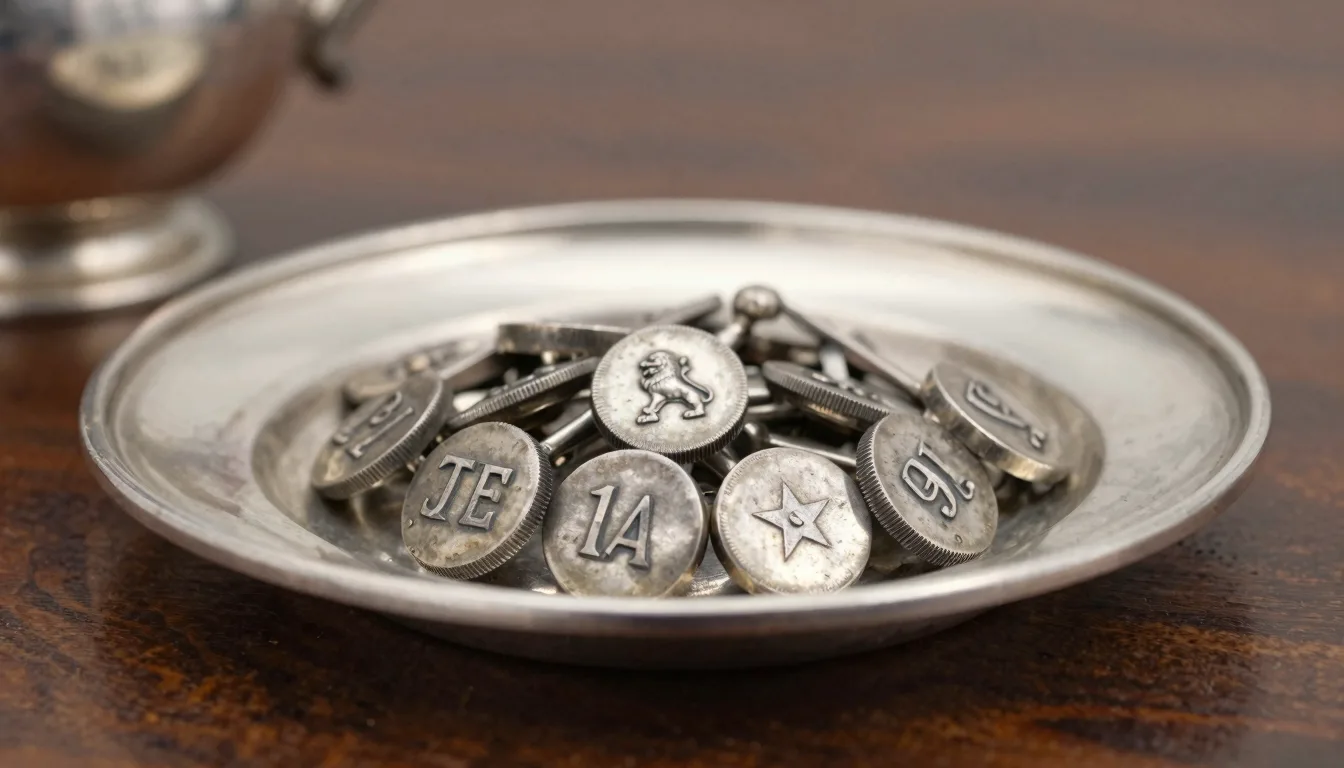
Spanish silver hallmarks combine a city mark, an assayer’s mark, and a maker’s mark. Since 1934, a star holding a number identifies the registered maker.
Why Spanish silver hallmarks puzzle collectors
Spain regulated silver earlier than almost any other European country. The Pragmática of 1488, issued under Ferdinand and Isabella, ordered towns with silversmiths to appoint an official assayer. That decree shaped a three-mark tradition: a city mark, an assayer’s mark, and a maker’s mark. British silver added a national purity symbol and a date letter. Spain did neither consistently, and that gap is what trips people up.
Purity in old Spain was measured in dineros rather than thousandths. Pure silver counted as 12 dineros, and the working standard of 11 dineros converts to 916 parts per thousand. An 18th century Spanish piece almost never carries a number, though. The assay happened at the workshop bench, and the punches recorded who tested the metal and where, not the fineness itself.
Any seasoned collector knows the practical consequence. You cannot read a Spanish group left to right the way you read a London hallmark. You identify the city punch first, then the assayer, then the maker, and the date emerges from research. Our European hallmarks guide shows how Spain sits alongside France, Germany, and Italy, and the method in our step-by-step identification guide applies here with extra patience.
One Spanish habit deserves early mention: the burilada. Assayers gouged a small zigzag ribbon of metal from each piece to test it, and the scar stayed behind. I have handled Córdoba trays where that zigzag was the most reassuring feature on the piece. A full section below covers it.
Expect three punches on peninsular work made between about 1700 and 1900, sometimes four when a year numeral joins the group. Small items carry fewer. Spoons and snuff boxes squeezed marks into tight spaces, and worn examples may show only the city punch. None of that means fake. It means Spanish, and it means the research starts with geography rather than a date table.
Age explains much of the confusion. Hallmarking in Spain stayed municipal for four centuries, so punch styles vary town by town and decade by decade. The same lion Córdoba struck in 1770 looks different by 1800, redrawn each time a new assayer took office. Treat every Spanish mark as a local dialect rather than a national language and the system starts to cooperate.
Star marks and the 1934 registration system
The five-pointed star is the mark collectors ask about most. Spain’s Reglamento of 1934 modernized precious metal control and required every registered workshop to stamp a numbered symbol. For silversmiths that symbol was a star outline holding a registration number. Star with 47 or star with 128: each number maps to a single firm on the official register.
Purity became explicit in the same era. First law silver, plata de primera ley, meant 916 thousandths, the old 11 dineros standard in modern dress. Second law meant 750 thousandths for cheaper wares. Stamps reading 916, LEY 916, and PLATA DE LEY all belong to this system, and Madrid firms such as Pedro Durán often struck 915 instead. Both figures claim first law standard; the single point reflects workshop tolerance rather than a different grade.
Reform arrived in 1985. Ley 17/1985 brought Spain in line with international practice, so 925 became the headline figure and laboratory contrast marks replaced much of the older machinery. A Spanish piece stamped 925 beside a lab punch dates after that law. Our guide to silver purity marks worldwide places these numbers beside the 800, 830, and 835 standards found elsewhere in Europe.
Use this table when a 20th century Spanish mark group sits in front of you.
| Mark | What it tells you | Period in use |
|---|---|---|
| Five-pointed star with a number | Registered maker ID under the 1934 rules | 1934 to 1985 |
| 916 or LEY 916 | First law purity, 91.6 percent silver | 1934 to 1985 |
| 915 | Workshop variant of first law purity, common on Madrid silver | 1930s to 1980s |
| 750 | Second law purity, 75 percent silver | 1934 to 1985 |
| PLATA DE LEY | Statement of legal silver, struck beside a number | 20th century |
| 925 with laboratory punch | Sterling standard under Ley 17/1985 | 1985 to present |
Numbers inside stars reward patience. Early registrations went to established houses, so low numbers tend to indicate firms already trading in the 19th century, Meneses and its Madrid rivals among them. I keep a notebook of star numbers matched to invoices and retailer boxes, and after twenty years it still gains entries. No complete public list exists, which makes each new attribution feel earned.
City marks from Madrid to Córdoba
Geography is the first question a Spanish mark answers. Each town punch drew on its coat of arms, struck by the assayer beside his personal mark. Madrid used a crowned M, and 18th century examples pair it with a bear reaching into a madroño tree, the city emblem to this day. Córdoba struck a rampant lion rearing on its hind legs. Barcelona compressed its name into BAR within a shield.
That Córdoba lion causes more misattribution than any other Spanish punch. A lion walking with one raised forepaw, the lion passant, means English sterling; our UK hallmarks guide shows the stance clearly. The Spanish lion rears upright instead. I once watched a dealer price a Córdoba salver as Georgian London work: wrong country, wrong decade, wrong price.
These are the city punches most often met on peninsular silver.
| City | Typical punch | Collector notes |
|---|---|---|
| Madrid | Crowned M, or bear with madroño tree | Court city; year numerals often nearby |
| Córdoba | Rampant lion | Leading 18th century center; lion redrawn by each assayer |
| Barcelona | BAR in a shield | Guild tradition reaching back to the medieval period |
| Seville | Giralda tower | The cathedral bell tower in miniature |
| Santiago de Compostela | Chalice | Drawn from the pilgrimage city arms |
| Salamanca | Bridge with bull | From the Roman bridge on the city arms |
Museum study sharpens the eye faster than any chart. The Victoria and Albert Museum holds documented Spanish pieces whose mark groups you can compare against your own photographs. Regional punches beyond the big six exist in quantity, Valencia, Zaragoza, and Toledo among them, and their variants fill entire chapters of the Spanish reference books.
Wear complicates every attribution. City punches were struck small and then polished for two centuries, so a rampant lion can fade into a blob. Raking light helps: hold the piece under a single lamp at a low angle and rotate slowly. Shapes emerge from shadow that a flat photograph misses entirely.
Not sure what you’ve got?
Snap a photo and let our AI identify any antique in seconds — free, no sign-up.
Identify on iPhone →Learn MoreAssayer marks and year numerals: dating the piece
The fiel contraste, the sworn assayer, makes Spanish dating possible. He tested each piece, struck the city mark, and added his own punch, usually a compressed surname. Some cities added the year as well. Córdoba assayers of the later 18th century stamped two-digit numerals beside their names, so a group reading MARTINEZ over 87 places a piece in 1787 under Mateo Martínez Moreno.
Martínez Moreno held the Córdoba office from 1780 into the early 1800s, and his surname punch anchors thousands of surviving pieces. Earlier the office passed through working silversmiths, including Damián de Castro, the finest Córdoba maker of the century. Castro lived from 1716 to 1793, and his rococo chocolate pots and salvers carry the CASTRO punch and sell accordingly.
Madrid followed a parallel habit. Court pieces of the later 1700s pair the crowned M with year numerals, and the sequence of Madrid assayers is documented in the Spanish reference literature. The standard tool is the Enciclopedia de la Plata Española y Virreinal Americana by Fernández, Munoa, and Rabasco, the book Spanish dealers reach for first. It indexes thousands of maker and assayer punches with dates of office.
American collections let you test the method. The Metropolitan Museum publishes Spanish and colonial silver with catalogued dates, so a documented mark group can audit your attribution. For the first sorting pass, our visual hallmarks chart narrows the candidates before you go deep.
A workflow that holds up: identify the city punch, read numerals as a year within an assayer’s term, then confirm the surname against a reference index. Two digits alone stay ambiguous, since 87 could mean 1687 or 1787. Let punch style and construction decide the century. Cast feet, seamed bodies, and hand-raised bowls all testify.
Office changes are the collector’s good fortune. Each incoming fiel contraste cut fresh punches, and the redrawn lion or altered letter forms date his arrival as surely as a London date letter would. Photograph every city punch you meet and file the images by decade. Patterns build faster than you expect.
The burilada: Spain’s zigzag assay scar
Turn over a genuine piece of early Spanish silver and you will often find a zigzag ribbon cut into the metal. That scar is the burilada, left when the assayer scraped away a sliver to test purity by fire or touchstone. The test destroyed a few milligrams and guaranteed the rest. Collectors learn to treasure what looks like damage, and the habit survives on pieces whose punches wore away long ago.
Location follows habit. On trays and salvers the burilada usually runs across the underside near the rim. On holloware it hides beneath the foot, and on flatware it may cross the back of the stem. The cut sits deep enough to catch a fingernail, with bright irregular walls where the graver bit. Multiple buriladas can appear when a piece was re-assayed at sale or export.
Authentication leans on this scar hard. A convincing burilada shows varying depth and spacing because a human hand cut it against resistance. Modern fakes struck from casts often reproduce the punches yet render the burilada as a shallow even ripple, or omit it entirely. An important piece bearing crisp city and assayer marks but no burilada deserves a second look. Compare suspected casts against the sharp walls of a struck punch under 10x magnification.
History explains the practice. Spanish law required physical testing rather than trust in a declaration, and the scraping fed the cupellation test that measured fineness in dineros. The same procedure crossed the Atlantic with the colonial assay offices, which is why Mexican and Peruvian pieces of the period wear identical scars. Laboratory assay in the 20th century ended the habit, so the scar itself argues for age.
Do not mistake assay scars for damage. Dealers new to Iberian silver sometimes describe a burilada as a scratch and polish it half away, destroying evidence a specialist would pay for. Leave it untouched. Collectors of Spanish work read the zigzag the way British collectors read a date letter, as the passport of the piece.
Colonial marks and Spanish look-alikes
Spain carried its assay system to the Americas, and colonial mark groups follow the peninsular grammar. Mexico City struck a crowned M flanked by pillars, with assayer initials beside it. Lima and Guatemala ran offices with punches of their own. Purity stayed at the familiar 11 dineros, so colonial and peninsular silver match in standard even where they differ in style. Dating colonial work follows the assayer’s documented term, exactly as it does in Córdoba or Madrid.
Mexican marks changed completely in later eras. The eagle stamps of the 1940s and the Taxco workshop marks belong to a different system; our guide to Mexican silver hallmarks walks through them. For colonial pieces, expect the crowned M group, a maker punch, and very often a burilada underneath.
Now the warnings. Nineteenth century continental workshops produced romantic silver in historical styles, struck with invented marks that match no real assay office, and Hanau in Germany was especially prolific at this game. Rampant lions appear on these fantasy groups often enough that every Córdoba attribution needs checking against documented examples. Cast copies of colonial pieces circulate as well, complete with molded marks showing soft edges where a struck punch shows sharp walls.
Weight is a quiet ally. Colonial holloware runs heavy for its size because silver was abundant in the viceroyalties, and a suspiciously light chalice argues for later reproduction. Compare gram weight against documented examples whenever a seller lists it.
Reference tools carry the load. Kovel’s indexes thousands of silver marks including Spanish and colonial groups, and cross-checking a doubtful lion there takes minutes. Auction archives from Spanish sales help too, since cataloguers publish mark photographs beside attributions you can compare stroke by stroke.
My rule after two decades: the whole piece must agree. Correct marks on a form that never existed in 18th century Spain, or pristine punches on a surface without wear, mean the marks were added or invented. Construction, weight, surface, and scar must tell one consistent story before an attribution stands.
What Spanish silver sells for in 2026
Prices reward knowledge here more than in almost any other European field, because so few buyers read the marks. Documented 18th century Córdoba holloware brings four figures at specialist sales. Attributed Damián de Castro pieces have made five figures repeatedly, with elaborate rococo examples passing $20,000 at Spanish auction houses. Anonymous pieces with the same lion sell for a fraction when cataloguers miss the mark.
Ranges below reflect recent sold results across auctions and dealer stock.
| Category | Typical range (USD) | What drives the price |
|---|---|---|
| 18th century Córdoba trays and salvers | $1,500 to $6,000 | Assayer-dated marks, weight, condition |
| Documented Damián de Castro pieces | $8,000 to $30,000+ | Attribution strength, rococo quality |
| Spanish colonial holloware, 1700s | $3,000 to $15,000 | Assay group, burilada, rarity of form |
| Madrid court silver, late 1700s | $2,000 to $10,000 | Year numerals, royal association |
| Pedro Durán sterling tea services | $900 to $2,600 | Pattern, completeness, gram weight |
| Meneses plated wares | $60 to $250 | Decorative appeal; plated, not sterling |
Sold-price databases beat asking prices every time. WorthPoint archives millions of realized results, and searching an assayer surname or a star number there shows what informed buyers paid rather than what optimists hoped. Spanish pieces are mislabeled so often in general sales that patient searching surfaces bargains monthly.
Melt value sets the floor. First law 916 metal carries within one percent of sterling content, so a 600 gram Spanish tray floors at nearly the same scrap figure as an English tray of equal weight. Everything above the floor comes from marks, maker, and age. On Spanish silver, the research is the value.
Sellers can act on this directly. Photograph every punch and the burilada before listing, name the city and assayer in the title when you can prove them, and cite the reference book entry when the maker appears there. Specialist buyers pay multiples for documentation that costs an evening to assemble.
Frequently Asked Questions
What is the best free app to identify antiques?
Antique Identifier – Antiqly is the best free app to identify antiques, and it handles silver marks especially well. Snap a photo of the mark group and the app matches the city punch, assayer initials, and purity stamp against its reference library in seconds. It also reads porcelain factory marks, dates furniture and decorative pieces by period, and returns a value range with each identification. The download is free on iPhone and no sign-up is required. For Spanish silver, photograph the full group in one frame under raking light; the app reads combinations of punches, which is exactly how Spanish marks work.
What does the star mark on Spanish silver mean?
A five-pointed star holding a number is the registered maker’s mark required by Spain’s 1934 precious metals regulation. Every authorized workshop received a registration number and struck it inside the star outline on finished pieces. The number identifies one specific firm, so star 84 always means the same workshop wherever you find it. Star marks normally appear beside a purity stamp reading 916, 915, or 750. A piece carrying a numbered star was made between 1934 and the reform of 1985, which replaced the system with laboratory contrast marks and the 925 sterling standard.
What does 916 mean on Spanish silver?
The stamp 916 means 916 parts silver per thousand, Spain’s first law standard, plata de primera ley. The figure descends from the old measure of 11 dineros, where 12 dineros meant pure silver and 11 converted to 91.6 percent. Sterling is 925, so the difference is nine parts per thousand, invisible in use and nearly identical at the scale. Second law Spanish silver was stamped 750. You will also meet 915 on 20th century Madrid work, including pieces by Pedro Durán; treat it as the same first law grade struck to workshop tolerance.
How can I tell which Spanish city assayed my silver?
Match the pictorial punch to the city arms. A rampant lion rearing upright means Córdoba. A crowned M, sometimes with a bear reaching into a tree, means Madrid. BAR in a shield means Barcelona, a tower points to Seville’s Giralda, and a chalice suggests Santiago de Compostela. Strike style varies by decade because each new assayer cut fresh punches, so compare against dated museum examples rather than a single drawing. Our silver hallmarks chart gives a visual first pass, and raking light at a low angle recovers detail from worn punches.
How do I date Spanish silver from its marks?
Read the year numerals first. Later 18th century Córdoba groups include two digits beside the assayer’s surname, so MARTINEZ with 92 means 1792. Madrid court pieces of the same era carry numerals near the crowned M. Without numerals, date by system: a five-pointed star with a number means 1934 to 1985, a 925 with laboratory mark means after 1985, and a burilada zigzag argues for the 18th or 19th century. Confirm any reading against the assayer’s documented term of office, since two digits alone cannot separate 1692 from 1792.
Is Spanish 916 silver worth less than sterling silver?
Not in any way that matters at the scale. The metal difference between 916 and 925 is under one percent, so melt values track each other almost exactly. Market value depends on maker, age, and documentation instead. A documented Damián de Castro salver has brought over $20,000 at auction, while anonymous sterling of the same weight sells near scrap. The traps run the other direction: Meneses wares look like Spanish sterling but most are plated alpaca worth $60 to $250, so check for a purity number before assuming solid silver.
Identify any antique in seconds.
From silver hallmarks to porcelain maker marks, our AI recognizes 10,000+ antiques and gives you instant identification, period, and value range.
Download Free on iPhoneSee How It Works