
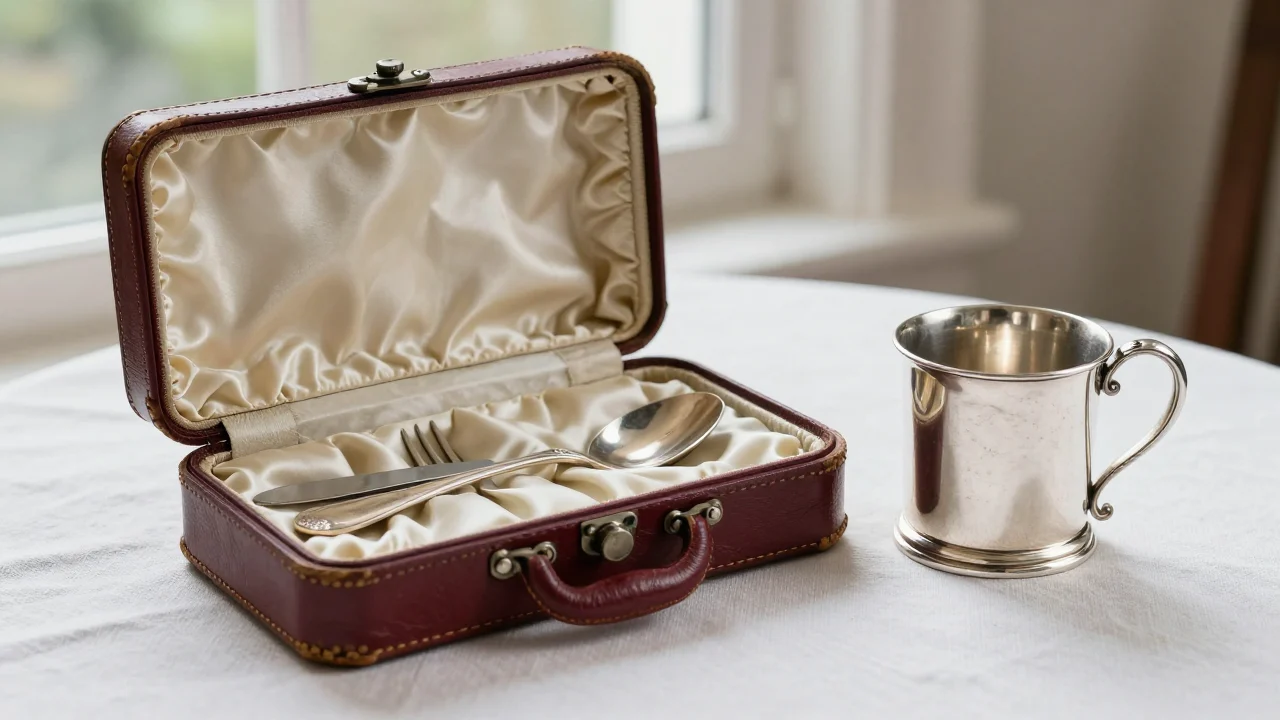
Cased three-piece silver christening sets made £30 to £45 at UK auction in 2015-2026; single mugs made £30 to £160 and a Cartier set with a mug made £1,000.
Every figure in this guide is a published auction result with the sale date and the lot page linked, so you can set your own cased set beside one that actually changed hands. Most results come from one saleroom, Cheffins of Cambridge. Three lots from Bonhams and Toovey’s are added because those two houses state on the lot page whether the figure includes the buyer’s premium. None of the figures is a dealer price, and none is the net amount a seller took home.
What is a silver christening set?
A silver christening set is a matched group of small pieces given to a child at baptism, most often a knife, fork and spoon in a fitted case, sometimes with a mug, bowl or plate. The Victoria and Albert Museum record for an 1864 George Adams set describes a six-piece christening set entirely of silver gilt in the Canova pattern, in its original presentation case, and notes that the set was intended as a future heirloom rather than for a very young child to use. The pieces are a knife, fork, spoon, cup, plate and bowl, and the mug and bowl carry the name of the baby and an inscription from the godfather who gave it.
Sets were often built up over several years. The V&A record for a Ramsden and Carr christening spoon of 1911-12 explains that the bowl and spoon were the first of three christening presents over three years, followed by a silver goblet in 1912 and a cutlery set of knife, fork and spoon in 1913. The museum adds that silver was popular since it could be engraved with inscriptions for the occasion, which is why so many surviving sets carry a name and a date.
The tradition is older than the fitted case. The Wikipedia article on apostle spoons records that by the sixteenth century they had become popular as baptismal presents for godchildren, but were dying out by the 1660s, and that in some communities this tradition continued until at least the mid-twentieth century. A single apostle spoon is a different market from a cased Victorian set, and the guide to old silver spoons covers it separately.
Where are the hallmarks on a christening set?
Each piece in a christening set is hallmarked on its own, so read the spoon, the fork and the knife handle one by one rather than letting the case stand for the date. The Cheffins condition report on an 1852 George Unite set records clear legible hallmarks to the spoon and knife, and the V&A lists its Adams set as marked G A / London hallmark for 1864 on all six silver pieces. On a knife the marks sit on the silver handle; a blade can be a later replacement and does not date the set.
Look for the five component marks the Goldsmiths’ Company lists for a full traditional UK hallmark: the sponsor’s mark, where the mark is composed of their initials inside a shield shape, the two fineness marks, the assay office mark and the date letter. The office marks are a leopard for the London Assay Office, an anchor for the Birmingham Assay Office, a rose for the Sheffield Assay Office, and a castle for the Edinburgh Assay Office. The UK hallmarks guide sets out the date letter cycles office by office, and the silver marks guide walks through reading the sequence for the first time.
Imported sets carry a different group of punches. The Cartier set sold in February 2026 is catalogued as stamped 925 with a London Leo import mark, and dated for 1931, so the London mark records the year of import, not the year of making. A piece that shows only a 925 stamp and no assay office mark cannot be dated from the marks alone.
Retailers also assembled sets from more than one maker and year. The Bonhams Hunt & Roskell set pairs a goblet of 1870 with a knife, fork and spoon by Francis Higgins, London 1868/9, and the footnote adds that the goblet is stamped HUNT & ROSKELL and numbered 5581. Write down the marks on every piece before you settle on one date for the set.
What do gross weight and weighable silver mean on a christening set?
Gross weight includes the knife blade, any filled handle and whatever else sits on the scale, so it overstates the silver in a christening set. Cheffins catalogues the 1852 Unite set at gross weight, 50.5g (1.62ozt) for the three pieces, and Bonhams gives the 1912 Garrard set as weight 160gms gross. Where a saleroom can weigh the silver alone it says so: the Hunt & Roskell set is listed as weight of weighable silver 8oz, and the Cartier plate, bowl and mug as 15ozt.
The distinction matters because a three-piece cutlery set holds very little silver. Three pieces at 50.5g gross contain less metal than a single christening mug catalogued at 140g, and that gap runs through the results below. The melt value guide shows how weighable silver feeds a scrap calculation; the results here show that buyers of cased cutlery sets rarely pay far above it.
What are silver christening sets worth?
A cased three-piece christening set is worth £30 to £45 at auction, a bowl-and-spoon or four-piece set £50 to £115, a single christening mug or cup £30 to £160, and a retailer set that includes a mug or goblet £687.50 to £1,000, on the published results below. The first table gives the bands and what set the price within them; the second lists every lot behind those bands in descending order, with a link to the page where the full description and any condition report can be read.
Salerooms publish the figure in different ways. Cheffins prints one figure per lot and does not say on the lot page whether the buyer’s premium is included. Bonhams prints its figure as inc. premium. Toovey’s prints the hammer price and states beside it that the buyer’s premium is an additional charge on each lot sold and that currently this is set at 24.5% plus VAT (29.4% including VAT) of the hammer price. The V&A record of buying its Adams set at Sotheby’s in 1996 shows the same split in a museum ledger: Price: £2117.25 (£1800 + £317.25). A seller receives the hammer price less commission, so treat every figure as the auction house’s published number rather than cash in hand. If you want to read the marks on each piece before you compare, photograph each hallmark with the free reader for iPhone and Android and check them against the rows below.
| Type | Result band | What set the price |
|---|---|---|
| Three-piece cased cutlery set (knife, fork, spoon) | Sold for £30 to £45 at Cheffins, 2015-2026 | Light gross weight, no maker or date catalogued in most lots; the Tiffany, Unite and Adams names did not lift the result |
| Bowl-and-spoon or four-piece set | Sold for £50 to £115 at Cheffins, 2013-2026 | More silver on the scale and a bowl that can still be used |
| Single christening mug or cup | Sold for £30 to £160 at Cheffins, 2014-2026 | Weight sets the floor (2.85ozt to 5.58ozt); the named modern silversmith (Durbin) and the retail house (Goldsmiths’ and Silversmiths’ Company) sit in the upper half |
| Set including a mug, goblet or plate from a top retailer | £687.50 inc. premium at Bonhams (2012) to £1,000 at Cheffins (2026) | Retailer name (Hunt & Roskell, Cartier), weighable silver 8oz to 15ozt, complete case |
| Christening set or piece | Maker, assay office and year | Result | Price driver |
|---|---|---|---|
| Three-piece set, plate, bowl and mug, enamelled ducks, 15ozt | Cartier, London import mark 1931 | Sold for £1,000 on 26 February 2026 | Retailer name and weight despite worn enamel |
| Four-piece set with goblet, cased, weighable silver 8oz | Hunt & Roskell and Francis Higgins, London 1868-1870 | Sold for £687.50 inc. premium on 12 June 2012 | Goblet plus cutlery from a top retailer, Bonhams Chester |
| Victorian christening mug, 140g (4.5ozt) | London 1875 | Sold for £160 on 8 January 2026 | Heaviest single mug in the sample |
| Christening mug, planished, engraved S.J.O. / 1954, 166.76g (5.36ozt) | Leslie Gordon Durbin, London 1954 | Sold for £150 on 23 October 2025 | Named twentieth-century silversmith |
| Late Victorian christening mug, 6.12oz | Goldsmiths’ and Silversmiths’ Company, London 1899 | Sold for £130 on 4 September 2014 | Weight and retail house |
| Silver-gilt knife, fork and spoon, Old English, initials JAED, 160gms gross | Sebastien Harry Garrard, London 1912 | Sold for £128 inc. premium on 12 December 2023 | Garrard name and Earl Haig provenance, still a cutlery-only set, Bonhams Edinburgh |
| Scottish christening cup, gadrooned rim, 173.5g (5.58ozt) | J C & Co, Edinburgh 1900 | Sold for £120 on 6 November 2025 | Weight and Edinburgh mark |
| Christening set with one extra spoon, 93.8g (3ozt) | London 1918 | Sold for £115 on 5 May 2026 | Highest cutlery-type set; weight stated, timed online sale |
| Victorian christening mug, 88.7g (2.85ozt) | I S Greenberg & Co, Birmingham 1887 | Sold for £110 on 8 January 2026 | Light but dated and complete |
| George III christening mug with monogram, 5.6ozt | London 1797 | Sold for £90 on 31 May 2018 | Georgian date, monogram R.H.B.R |
| Cased set of bowl and spoon | Maker not catalogued | Sold for £70 on 5 September 2013 | A bowl adds usable silver |
| Quaich pattern bowl 1934 and pierced spoon 1929, fitted case (a/f) | GH and CJA, Sheffield | Sold for £60 on 14 December 2017 | Bowl and spoon, case noted as damaged |
| Four-piece christening set | Maker not catalogued | Sold for £50 on 7 November 2013 | One piece more than a trio |
| George VI christening mug, cased | Birmingham 1937 | Sold for £50 on 2 November 2017 | Late date, small mug |
| Victorian three-piece set | George Adams, London 1872 | Sold for £45 on 12 February 2015 | Same maker as the V&A set, trio only |
| Christening spoon and fork, engraved, cased | John Newton Mappin, London 1883 | Hammer price £45 on 26 February 2014 | Hammer only; premium added on top, Toovey’s |
| Knife, spoon and fork in original oval case, 50.5g (1.62ozt) gross | George Unite, Birmingham 1852 | Sold for £40 on 6 June 2026 | Early date and clear marks, still a light trio |
| Three-piece set, knife, fork and spoon | Tiffany | Sold for £40 on 15 January 2015 | Retailer name did not lift a trio |
| Two cased three-piece sets in one lot | Maker not catalogued | Sold for £40 on 27 July 2017 | Two sets for the price of one |
| Cased three-piece set | Maker not catalogued | Sold for £40 on 19 March 2015 | No maker or date catalogued |
| Three-piece set | Cooper Bros, Sheffield circa 1911 | Sold for £35 on 16 April 2015 | Edwardian trio |
| Cased christening set | Maker not catalogued | Sold for £30 on 15 February 2018 | Uncatalogued trio |
| George VI christening mug, inscribed Sarah, 3.3ozt | Dublin | Sold for £30 on 13 May 2021 | Small, inscribed with a first name |
Why do cased cutlery sets sell for so little?
Cased cutlery sets sell for little because they hold little silver, they come to market in large numbers, and the names engraved on them belong to someone else. A search of the Cheffins archive for silver christening on 19 September 2026 returned 361 past lots, most of them mixed groups, from a single regional saleroom. The Unite set of 1852 weighs 50.5g gross for three pieces and made £40 with clear marks and its original oval case. The Tiffany trio made £40 and the George Adams trio £45 in the same year, so a famous retail or maker name did not move a knife, fork and spoon out of the band. Even the Garrard silver-gilt set from the collection of the late Earl and Countess Haig made £128 inc. premium at Bonhams, the highest cutlery-only result in the table and still below both sets that included a mug or goblet.
Cataloguers often group cased sets with other small silver. Many appear inside mixed lots rather than on their own: one Cheffins lot of June 2024 combined two cased Victorian silver christening sets, one with mother of pearl handles, and a small silver jug, 121g (3.9ozt) gross weighable silver, with a plated christening mug and a pickle fork, and the whole group brought £130 on 13 June 2024. A set sold inside a group never gets a price of its own, which is one reason so few single-lot results exist for an object that is so common.
Condition finishes the job. The 1934 quaich bowl and spoon are catalogued in a fitted case (a/f), the trade shorthand for damage, and made £60. Buyers bid on a damaged case, a replaced knife blade or a bent fork tine as they are, fault included, and the result stays in the band.
Which christening sets do sell?
Sets that include a mug, bowl or plate sell, and a top retailer’s name on those pieces matters more than the cutlery maker’s. The Cartier three-piece set of plate, bowl and mug made £1,000 in February 2026 even though the condition report reads enamel reserves rather worn, numerous surface scratches and some minor dents. The Hunt & Roskell set made £687.50 inc. premium in 2012 with a goblet in the case beside the Higgins cutlery. Both results rest on 8oz to 15ozt of silver and a name a buyer can look up.
A single mug outsells a trio on its own. The Victorian mug of London 1875 at 140g made £160, the Durbin mug of 1954 at 166.76g made £150, and the Edinburgh cup of 1900 at 173.5g made £120, each of them above every cutlery-only lot from Cheffins. Weight sets the floor rather than the order: the two lightest mugs, the 88.7g Greenberg mug at £110 and the 3.3ozt Dublin mug at £30, sit in the lower half, but the 140g London mug outsold the heavier Edinburgh cup, so date, form and maker move a mug within the band.
The V&A record shows what turns the same maker into a museum piece. George Adams made both the six-piece silver-gilt set the museum bought at Sotheby’s in 1996 and the three-piece set that made £45 at Cheffins in 2015. The difference is six pieces including a cup, plate and bowl, gilding, a named pattern shown at the Great Exhibition, and the original case with the recipient’s initials. A trio by the same hand, without those things, stays in the trio band.
Do engraved names and dates lower the value?
An engraved name does not by itself decide the result in these lots; weight and the presence of a mug decide it. The Dublin mug inscribed Sarah made £30 at 3.3ozt, while the Durbin mug engraved S.J.O. / 1954 made £150 at 166.76g, and the Garrard trio engraved with initials JAED made the highest cutlery-only price in the table. The George III mug of 1797 with monogram made £90, in the middle of the mug band.
Names help when a buyer can trace them. The Garrard set carried the Earl Haig provenance on the Bonhams page, and the V&A set names the baby, Jane Dunlop Best, and records that her godfather gave it. The napkin ring values guide reports that christening rings with full names and dates do well with collectors of dated silver; in this sample the inscribed lots spread across the whole range, so a name is a record to keep, not a price signal on its own.
What should you do with your christening set now?
Start by taking each piece out of the case and recording its hallmarks separately, in daylight with a magnifier, noting the sponsor’s mark, the assay office, the date letter and any 925 or import mark, and writing down which pieces, if any, are unmarked. Then weigh the set and decide what you are looking at: gross weight for a trio with a filled knife handle, weighable silver only for pieces you can weigh on their own, and a note of whether a mug, bowl or plate is present. Finally, find the row in the table that matches your set’s contents, maker’s town and weight, open the lot page, and compare the description and any condition report line by line with the pieces in front of you before you set a reserve, an insurance figure or a bid.
Method and limits. Cheffins results are the single published figures on lot pages between September 2013 and June 2026, read on 19 September 2026; premium inclusion is not stated on those pages. The two Bonhams figures are stated inc. premium and the Toovey’s figure is a hammer price; the three are shown in the table with their saleroom named and are not merged into the Cheffins bands. No dealer, online-marketplace or private-sale prices are used. Descriptions and condition reports are the cataloguer’s, not an independent examination, and lots catalogued without a maker or date may be better or worse than their entry suggests. Hallmark explanations follow the Goldsmiths’ Company and the V&A; a mark, a case or an inscription is a starting point, and none of them proves date, maker or metal on its own.