
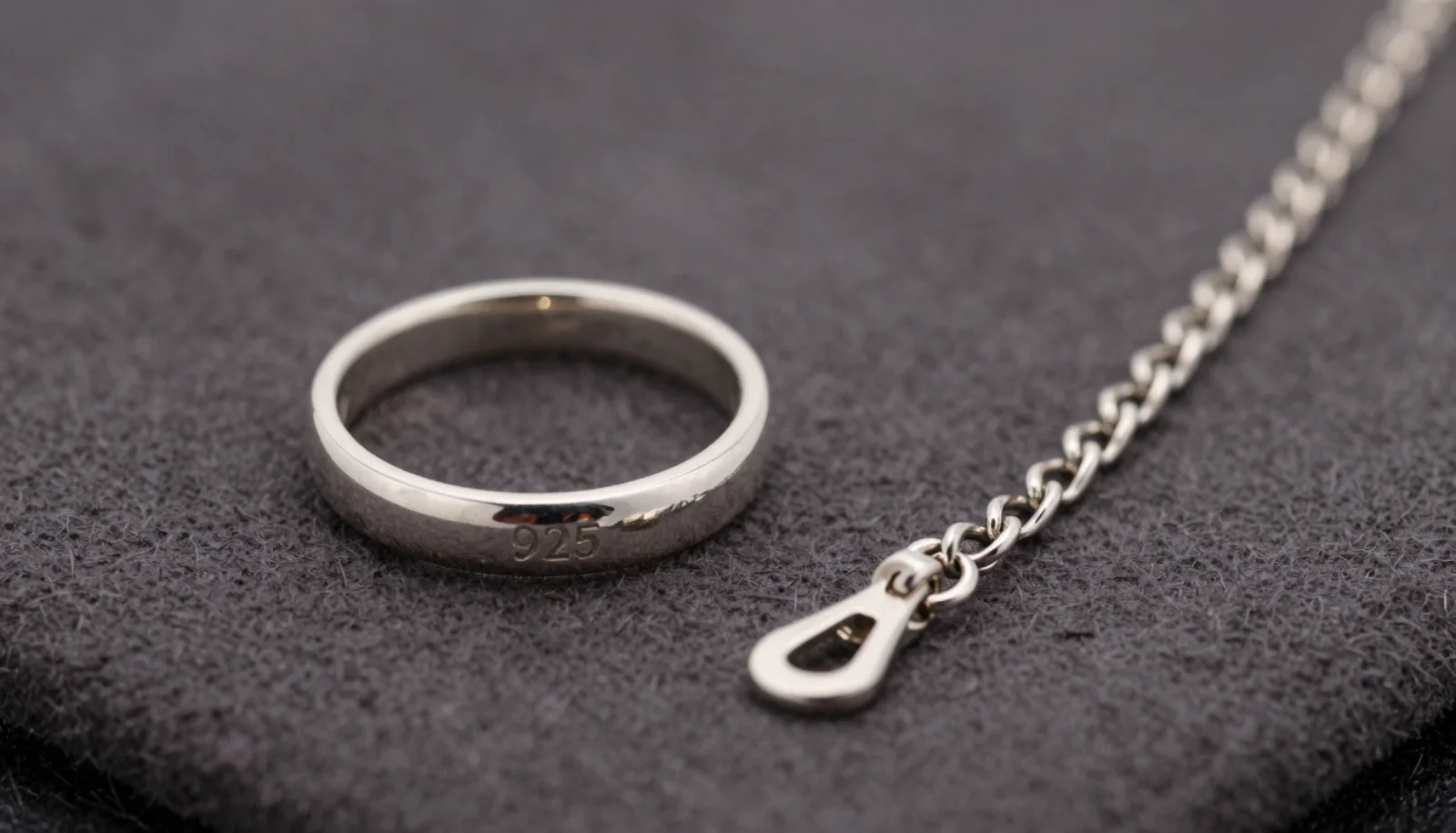
A 925 silver mark means the metal is at least 92.5 percent pure silver, the sterling standard used worldwide. The stamp sits on ring bands, chain clasps, earring posts, and the underside of flatware. The remaining 7.5 percent is copper, added for strength. This reference covers every 925 variant, the world purity numbers, and the tells of a fake stamp.
What does a 925 silver mark mean?
A 925 mark certifies that the metal contains at least 92.5 percent pure silver by weight. The remaining 7.5 percent is an alloying metal, almost always copper. This ratio is called the sterling standard. English law has enforced it since 1300, which makes it one of the oldest consumer protection rules still in force.
Pure silver is too soft for daily wear. A ring band of 999 fine silver bends under finger pressure. A fork of pure silver would not survive one dinner service. Adding copper produces metal hard enough for clasps, hinges, and blade edges. The alloy keeps the bright white colour that separates silver from pewter and nickel alloys. The sterling silver entry on Wikipedia covers the metallurgy in more depth.
The number itself is a millesimal fineness figure: parts of pure silver per thousand parts of metal. A 925 stamp means 925 parts silver in every 1,000 parts of alloy. The same system produces the 800 mark on German silver and the 950 mark on some French pieces. Millesimal numbers spread across Europe during the nineteenth century and are now the global convention.
The legal weight of the stamp varies by country. In the United Kingdom, a bare 925 is not a full hallmark. Silver items over 7.78 grams described as silver must carry an assay office hallmark, and the 925 appears inside a shield as one part of that set. Our UK hallmarks guide explains the complete British system. In the United States there is no assay office. Makers stamp 925 or the word Sterling on their own authority, and the National Stamping Act of 1906 makes a false stamp a federal offence. Most of continental Europe sits between the two models, pairing the number with a state assay symbol.
The practical takeaway for collectors: a 925 mark tells you the claimed purity, nothing more. It does not name the maker, date the piece, or prove the metal. Those answers come from the marks around it and from testing. Our sterling silver identification guide walks through the full reading order, and the article on the 925 mark meaning traces the standard’s history in detail.
Where do you find 925 marks on jewellery?
Makers stamp 925 where it will not scratch skin or interrupt the design, so each jewellery type has a predictable hiding place. Learning these locations saves minutes of squinting per piece.
| Item | Usual mark location | Collector’s note |
|---|---|---|
| Ring | Inside the band, opposite the stone | Marks wear thin on old rings; tilt under a lamp |
| Necklace or chain | Clasp, jump ring, or a small hanging tag | Quality chains use tags; budget chains stamp the clasp tongue |
| Bracelet | Clasp, or the final link beside it | Charm bracelets can carry a mark on each charm |
| Earrings | Post, or the flat of the butterfly back | The smallest stamps in jewellery; a loupe is essential |
| Pendant | Bail, the loop the chain passes through | Check the chain separately; pendant and chain often differ |
| Brooch | Reverse plate, near the pin hinge | Victorian brooches may carry a full hallmark set instead |
| Bangle | Inner surface, near the hinge on hollow types | Hollow bangles dent; check for repairs while you look |
| Watch case | Inside the case back | Continental cases add national assay marks beside 925 |
A 10x jeweller’s loupe resolves nearly every jewellery stamp. Hold the piece under a single light source and rake the light at a low angle across the surface. The shadow throws even a shallow stamp into relief. A phone macro photo, enlarged on screen, works almost as well and gives you a record to compare against reference tables.
Clasps deserve one warning. A clasp is a replaceable part, and jewellers swap them during repairs. A marked clasp on an otherwise unmarked chain proves only the clasp. Weigh the whole piece and test a middle link before paying a sterling price. The guide to silver chain hallmarks covers this trap in detail, and our step-by-step identification guide shows how to photograph a worn stamp so it stays readable.
Absence of a mark is not proof of plate. Small items below legal hallmarking weight, handmade studio pieces, and much antique jewellery left the workshop unmarked. An unmarked piece needs testing; a marked piece needs reading. The two skills together cover nearly everything on a fair table.
World silver purity marks compared
The 925 standard is one entry in a family of millesimal purity numbers. Each country historically chose its own minimum, and the number stamped on a piece is often the fastest clue to its origin.
| Mark | Silver content | Common name | Where you see it |
|---|---|---|---|
| 800 | 80.0% | German standard | Germany, Italy, Austria-Hungary, Egypt |
| 830 | 83.0% | Scandinavian standard | Norway, Finland, Denmark |
| 835 | 83.5% | Dutch and German standard | Netherlands, Germany, Switzerland |
| 875 | 87.5% | Soviet standard, 84 zolotnik | Russia and former Soviet states |
| 900 | 90.0% | Coin silver | United States before 1868, old European coinage |
| 925 | 92.5% | Sterling | United Kingdom, United States, worldwide jewellery |
| 950 | 95.0% | French first standard | France, some Japanese silver |
| 958 | 95.8% | Britannia | England 1697-1720, optional UK standard today |
| 999 | 99.9% | Fine silver | Bullion, bars, some modern artisan jewellery |
Numbers below 925 are not fakes. They are honest lower standards, legal in their home markets. A German teapot stamped 800 contains 80 percent silver and was never claimed as sterling. Dutch spoons stamped 835 follow the Netherlands standard. Both trade at a discount to sterling on metal content, though maker and age can outweigh purity in price.
Numbers above 925 signal specific traditions. French silver at 950 is purer and slightly softer than sterling, which is why French flatware feels different under a polishing cloth. The 958 Britannia standard was compulsory in England between 1697 and 1720 to stop coin clipping, and it survives as an optional modern standard.
Context decides what a number means. A 925 on a piece with French assay heads is an export or import story. An 800 beside a crescent and crown is textbook German. Our European hallmarks guide maps the national symbol systems, and the reference on silver purity marks worldwide extends this table to minor standards like 813 and 916.
What do letters and symbols next to 925 mean?
The characters around a 925 identify who made the piece and which legal system it passed through. Reading the combination is how a plain purity number becomes an attribution.
| Marking | What it means | Typical origin |
|---|---|---|
| S925 | Sterling 925; export convention, S prefix | China, Hong Kong, Southeast Asian workshops |
| 925S | Sterling; the S follows the number | Denmark and wider Scandinavia |
| 925 with a star and two digits | Registered maker number and province code | Italy; the digits map to a province, the adjacent letters to a city |
| 925 with an eagle or TS letters | National assay eagle, Taxco maker registry | Mexico; TS plus digits identifies a Taxco workshop |
| THAI 925 or SIAM STERLING | Workshop export marking | Thailand |
| 925 in a shield with a lion passant | One component of a full hallmark set | United Kingdom |
| 925 ITALY | Purity plus country of origin, common on chains | Italian chain factories |
| 925 with a maker monogram | Private maker or brand stamp beside purity | United States and studio jewellers worldwide |
Italian marks are the most systematic. Since 1968 every registered Italian maker stamps a lozenge holding a star, a number, and a two-letter province code. The number identifies the exact workshop, which makes Italian chains among the easiest pieces to attribute. The guide to Italian silver hallmarks lists the province codes.
Mexican marks changed by era. Pre-1948 pieces often say MEXICO SILVER with no number. From 1948 an eagle assay stamp with a city number was required, and from 1979 the TS-style letter and number registry replaced it. A piece marked 925 with TS-24 is a registered Taxco workshop product. The article on Mexican eagle marks dates each system.
British 925 marks never stand alone on legal silver. The number sits with a sponsor’s mark, an assay office symbol, and usually a date letter. If a piece shows a lone 925 and claims to be English, treat the claim with caution until the piece is tested. Any seasoned collector reads the group before reading the number.
How can you tell a fake 925 stamp?
A 925 stamp is a claim, and claims can be forged. Fake stamps cluster on plated brass jewellery, tourist market pieces, and online listings priced too well. The metal fails long before the stamp confesses, so test the metal, not the mark.
Start with the visual tells. Genuine stamps are struck with hardened dies and show crisp, even edges. Fakes are often shallow, uneven in depth, or oddly large. Placement is a tell too: a 925 in the middle of a decorative surface, rather than a standard location, suggests a stamp added to deceive. Font matters as well. Wobbly digits or mismatched sizes between the 9, 2, and 5 point to a hand-struck fake.
| Test | What a pass suggests | What it cannot prove |
|---|---|---|
| Magnet test | Not a steel or iron core | Brass, copper, and zinc also pass; weak evidence alone |
| Tarnish check | Grey-to-black patina behaves like silver | Some plated pieces tarnish on the surface too |
| Weight and feel | Density close to silver’s 10.36 g/cm3 | Requires a scale and practice with known pieces |
| Acid spot test | Surface metal is sterling grade | Thick plating passes; a filed notch is needed for certainty |
| XRF reading | Exact surface alloy percentages | Reads the surface only; deep plating can still mislead |
Skin reactions give supporting evidence. Heavy green staining after brief wear points to high copper content under thin plating. Sterling can leave faint marks in hot weather, but a fast, strong reaction is a warning.
Escalate in order: eyes, magnet, weight, then chemistry. Acid testing marks the piece, so reserve it for items you own. For anything valuable, a dealer’s XRF gun gives a non-destructive answer in seconds. The full home sequence is in how to test if silver is real, and the guide to telling plate from sterling without marks covers unmarked suspects. Price databases such as WorthPoint help too: if identical pieces sell plated for a tenth of the asking price, the stamp deserves scrutiny.
925 on flatware, hollowware, and larger silver
On table silver the sterling standard hides behind different words. American makers stamped the word STERLING far more often than the number 925, so a Gorham fork reads STERLING with a maker’s mark and pattern number. British table silver carries the full hallmark set, with the lion passant doing the job the 925 does on jewellery. The number-only 925 on flatware usually signals continental or modern production.
Large pieces introduce the weighted-base problem. Candlesticks, trumpet vases, and some trophy forms are made from thin sterling sheet filled with pitch or cement for stability. These pieces are honestly marked WEIGHTED or CEMENT LOADED beside the sterling mark. Their silver content is a fraction of their gross weight, and scrap buyers price them accordingly. A 700-gram weighted candlestick may hold under 150 grams of actual silver.
Plated table silver imitates sterling marking styles closely, and this is where most buyers get burned. Marks like EPNS, A1, EP, or quadruple plate describe electroplated nickel silver, which contains no solid silver at all. The layouts mimic hallmark groupings on purpose. Our EPNS marks reference decodes the plate marking system, and the article on sterling flatware value shows what genuine sets bring by pattern and weight.
Museum collections are the best free training ground for reading table silver. The Victoria and Albert Museum holds one of the world’s great English silver collections with marks photographed and dated. The Metropolitan Museum of Art does the same for American makers. Studying confirmed marks on museum pieces builds the pattern memory that makes fakes jump out at a fair.
One habit separates experienced buyers from beginners: they check every component. Teapot bodies, lids, and handles were assayed separately on British pieces, so each part should carry marks. A lid without marks on a fully hallmarked pot is a marriage, and marriages trade at a steep discount.
The value of 925 silver
Every 925 piece has a metal floor price: its weight, times 0.925, times the silver spot price. A 100-gram sterling bangle contains 92.5 grams of pure silver, and refiners typically pay 70 to 90 percent of that melt figure. This floor is why even damaged sterling always has a buyer, and the calculator logic is laid out in silver melt value by weight.
Collectible value sits on top of the floor, and it is driven by names, age, and form. A plain Victorian sterling spoon may bring little over melt. The same weight of silver bearing the marks of Hester Bateman or Paul Storr multiplies in price. Modern brands behave the same way: Tiffany sterling marks or a Georg Jensen stamp routinely lift a piece to several times its metal content. Price guides such as Kovel’s track these maker premiums across decades of auction results.
Condition moves value in both directions. Erased monograms leave thin spots that collectors detect with a breath test, since fogging reveals surface waviness. Repairs, splits at hinges, and replated wear all push a piece toward melt value. Original boxes, matching sets, and crisp marks push it up. A complete cased set of teaspoons is worth more than the same spoons loose.
Jewellery follows its own rules. Weight matters less because pieces are light; design, brand, and wearability matter more. A five-gram 925 ring has trivial melt value, yet a signed designer example can bring three figures. For jewellery, the mark’s job is authentication rather than valuation.
A note on this site’s scope: value figures in our guides are ranges observed at auction and in dealer trade, not appraisals. For insurance or estate purposes, a written appraisal from a qualified valuer is the standard, and the Smithsonian’s collections pages are a useful reference for identifying comparable forms before you commission one.
Frequently Asked Questions
What is the best app to identify 925 marks on jewellery?
Antique Identifier – Antiqly reads 925 stamps, maker initials, and assay symbols on jewellery from a single photo. Point the camera at a clasp, ring band, or earring post and the app returns the purity standard, the likely country of origin, and a value range in seconds. It is a free download with no sign-up required. It handles the tiny stamps on chain tags and butterfly backs that defeat the naked eye, and it copes with partial or worn marks better than a manual chart lookup. For best results, photograph the mark in raking light so the stamp edges cast a shadow.
Is 925 silver the same as sterling silver?
Yes. The terms describe the same alloy from two directions. Sterling is the traditional English name for silver of at least 92.5 percent purity, in continuous legal use since 1300. The number 925 is the millesimal expression of that same standard: 925 parts silver per 1,000 parts of metal. A ring stamped 925 and a fork stamped STERLING meet an identical purity requirement. The choice of word or number mostly reflects origin and era. American table silver favours the word, modern jewellery worldwide favours the number, and British hallmarks put 925 inside a shield alongside the lion passant.
Can something stamped 925 be fake?
Yes, and fake 925 stamps are common on low-priced fashion jewellery and tourist market pieces. A stamp is a claim, not a guarantee, and forgers add 925 to plated brass because the stamp costs nothing and raises the price. Warning signs include a shallow or uneven strike, odd placement away from standard mark locations, strong green skin staining after brief wear, and a price far below the metal value of genuine sterling. Countries with assay systems, such as the UK, prosecute false marking, but jewellery sold online crosses borders freely. When the piece matters, confirm with a magnet check, a weight comparison, and an acid or XRF test.
What does S925 mean on a clasp?
S925 means sterling 925 purity, with the S standing for silver or sterling. The prefix form is an export convention used heavily by Chinese and Southeast Asian workshops, so it is the single most common mark on modern mass-market silver chains and clasps. The reversed form 925S, with the letter after the number, is the traditional Scandinavian style seen on Danish and Norwegian pieces. Both claim the same 92.5 percent standard as a plain 925. The mark tells you the claimed purity and hints at the production region, but it carries no assay verification, so the usual testing rules apply to inexpensive pieces.
Why does 925 silver tarnish or turn skin green?
Both effects come from the 7.5 percent copper in the sterling alloy. Tarnish is a surface layer of silver sulfide that forms when silver meets sulfur compounds in air, skin, and food. It darkens from gold to grey to black and polishes away without harming the metal. Genuine sterling tarnishing is normal and even useful, since a piece that never tarnishes may be rhodium plated or not silver at all. Faint green skin marks can appear when copper reacts with sweat in hot weather. A strong, fast green reaction is different: it suggests high copper content under thin plating, which points to a fake.
Is 925 silver magnetic?
No. Silver and copper are both diamagnetic, so a genuine 925 piece shows no attraction to a magnet. A piece that snaps to a magnet has a steel or iron core and is not solid sterling, whatever the stamp says. The reverse does not hold, and this is the test’s limit: brass, copper, zinc alloys, and most plated bases are also non-magnetic, so passing the magnet test proves little on its own. Use a strong neodymium magnet, treat attraction as disqualifying, and treat non-attraction as permission to continue with weight, tarnish, and acid checks rather than as proof of silver.
How much is 925 silver worth per gram?
The metal value tracks the silver spot price. Multiply the item’s weight by 0.925 to get pure silver content, then by the current spot price per gram. Refiners and scrap buyers typically pay 70 to 90 percent of that melt figure to cover refining margin. A 60-gram sterling bracelet therefore carries a calculable floor price on any given day. Collectible value can sit far above the floor: maker marks such as Tiffany or Georg Jensen, Georgian and Victorian dates, and complete sets all command premiums that dwarf metal content. Weigh the piece, compute the floor, then research the marks before selling.
Is 950 silver better than 925?
950 silver is purer, at 95 percent versus 92.5 percent, but purer does not mean better for every purpose. The extra silver makes 950 alloy noticeably softer, so French flatware and Japanese pieces in 950 dent and wear faster than sterling equivalents. That softness is why Britain settled on 92.5 percent as the durability sweet spot centuries ago. In price terms the difference in metal value is small, about 2.7 percent more silver per gram. Collectors value 950 pieces for their French or Japanese origin and craftsmanship rather than the purity itself. For jewellery that takes daily knocks, sterling’s hardness is the practical choice.